

10 articles
One of the most celebrated times of year in Cornwall is late spring, when our coastline, ancient woodlands and historical gardens burst into life with the colourful display of bluebells. This rare and incredible display happens throughout the county, each with its own unique setting for this fabulous natural phenomenon.
To make it a little easier for you to plan your springtime itinerary, we have picked out the best bluebell displays in Cornwall, ranging from rugged coastal woodlands to beautifully manicured gardens. Enjoy.
Enys Gardens, Penryn
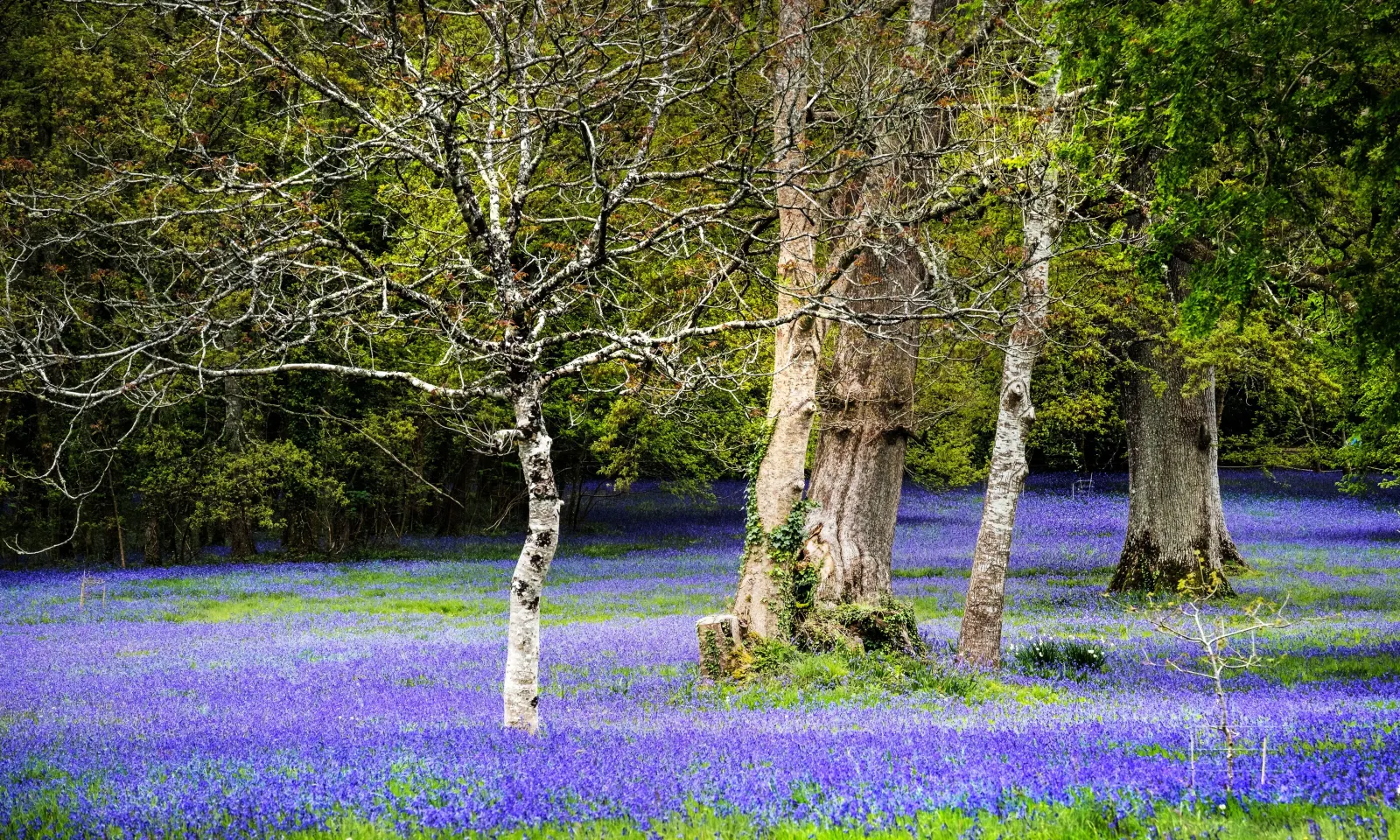
Both locals and visitors make a note in their calendar for the Enys Gardens bluebell display, calling it the ‘bluebell festival’. They open their gardens especially for the event, and share daily updates on the level of ‘bloom’, allowing you to choose the prime time to see their display. They claim to be one of the oldest gardens in Cornwall, with mentions in ancient texts.1 However, the gardens you see today were established both in the 18th and 19th centuries, and cover around 30 acres of the original estates’ grounds. The bluebell display here is quite unusual in that it forms a meadow of bluebells, where woodland once was. This means you have an uninterrupted blue carpet; it is truly mesmerising.
- Grid reference: SW 79128 36399
- What3words: ///tester.dimension.advice
Lanhydrock, Bodmin
One of Cornwall’s most impressive National Trust properties in Cornwall, Lanhydrock (near Bodmin) not only offers a wonderful bluebell display, but also an incredible house and garden to explore on your visit here too, making it a great day out. The woodland trail can be enjoyed either on foot or on bicycle and meanders its way through woodland, and alongside the River Fowey.2 After you’ve visited the woodland’s show of bluebells, you can make the most of your time here by taking a look in the shop and stopping by the cafe too. Alternatively take your time to enjoy the rest of the gardens, with large colourful plants such as camellias and rhododendrons creating an impressive backdrop to the beautiful low lying borders that surround the house.
- Grid reference: SW 79128 36399
- What3words: ///reason.shuffles.like
Camel Trail
Combine bluebell gazing with a full day out on this fantastic cycle trail in Cornwall. Lined with wildflowers and wild garlic at the same time of year, the Camel Trail runs along the river Camel, starting near Bodmin and finishing at Padstow, via Wadebridge, if you’re following the river downstream. However, if you’re looking to enjoy a cycle ride with a stop, we’d recommend travelling in the opposite direction and heading for Camel Valley vineyard, near Bodmin, for your well earned stop. Here you can enjoy a glass of award winning Cornish wine, whilst looking over the bluebell woods below. Then, you descend back to Padstow, enjoying the spring flowers on route. A great day out to see bluebells in an incredibly pretty natural environment.
- Grid reference: SW 91991 75300
- What3words: ///vanilla.underline.eagles
Penrose, Helston
A favourite place to visit in springtime is Penrose (near Helston). This is a National Trust property, but with fabulous walks around the Penrose estate and extending around the headland to Porthleven. You can make this into a circular walk via ancient trees, bluebells and the coast path onto the cliffs. In early May both the estate and the coast will be an abundance of colour and the bluebell display will be perfectly set off by the blues of the sea and sky beyond. You can park at the National Trust car park on the estate and a short walk from here you’ll find a cafe and loos.
- Grid reference: SW 65263 26876
- What3words: ///wipe.storming.predict
Tehidy Woods, Camborne
A wonderful and unusual woodland to visit in springtime for bluebells is Tehidy.3 It is council owned and enjoyed by many locally year round, but as many Country Parks do, it really comes into its element in late spring. Where Tehidy Country Park and its woodland floor fills with flowers. There are several car parks, a cafe and loo facilities available and the park itself is dog friendly.
- Grid reference: SW 64157 43568
- What3words: ///command.marketing.harps
Pencarrow House & Gardens, Bodmin
Tucked away on the edge of Bodmin moor, you’ll discover Pencarrow House. The house itself is impressive, but the 50-acre gardens also carry the x-factor. 4 They encourage visitors all times of year to see the beautiful displays of colour from the rhododendrons and camellias in early spring to the carpet of bluebells and wild garlic in late spring. There is also an iron age hill fort in the grounds of the house that is worth a look during your visit.
- Grid reference: SX 03600 71137
- What3words: ///skippers.conquest.headliner
Glendurgan Gardens, Falmouth
Another National Trust gem, Glendurgan Gardens, on the south coast near Falmouth, is a picturesque place, perfect for bluebell walks in May. The gardens are set in a valley that runs down to the Helford Estuary, and the woodlands within the grounds are scattered with bluebells in late spring. You and the family can take on the challenge of the maze in the centre of the gardens too! There is a sweet little cafe at the top, next to the car park and loos. You can also find an ice cream shop at the bottom of the hill in the little hamlet.
- Grid reference: SW 77205 27686
- What3words: ///wrong.proofread.ombudsman
Cardinham Woods, Bodmin
This natural beauty is quite a well kept secret. Tucked in the valley in North Cornwall near Bodmin, you can enjoy the peace and tranquility of a woodland walk here whilst taking in the pretty woodland floor covered in scattering of bluebells. It is dog friendly, has parking and a great little cafe, the Wood Cafe, if you’re looking for a local Cornish cream tea during your visit.
- Grid reference: SX 11326 67743
- What3words: ///commoners.prouder.fears
Article Sources
- Enys Gardens (no date) The Gardens, Enys Gardens. Available at: https://enysgardens.org.uk/gardens Enys Gardens[↩]
- National Trust (no date) Lanhydrock, National Trust. Available at: https://www.nationaltrust.org.uk/visit/cornwall/lanhydrock National Trust[↩]
- Cornwall Council (no date) Tehidy Country Park, Cornwall Council. Available at: https://www.cornwall.gov.uk/parks-leisure-and-culture/parks-and-open-spaces/country-parks/tehidy-country-park Cornwall Council[↩]
- Pencarrow House & Gardens (no date), Welcome to our beautiful grounds. Available at Pencarrow House & Gardens[↩]
Frequently Asked Questions
The best month for bluebells in Cornewall is May. They start flowering at the end of April and remain in flower right the way through to the end of May
Whilst there isn’t a specific date, they start to flower from the end of April, so the best time to see them in full bloom is early – mid May.
Two top spots for bluebells in Devon: Holyford Woods, Seaton, with its ancient woodland trails, and Killerton Estate near Exeter, a National Trust property where gardens and woodlands transform into a bluebell carpet each spring, complete with facilities and year-round events.
Clumber Park, Nottinghamshire, is a top spot for bluebells. Its ancient woodlands and three-mile path create a breathtaking display from late April, making it hard to beat for size, history, and beauty.
Yes, native British bluebells (Hyacinthoides non-scripta) are found throughout Cornwall. They thrive in ancient woodland and shaded areas, making Cornwall’s historic forests ideal for bluebell displays.
Yes, Cornwall is one of the few places in the UK where you can see bluebells near the coast. Coastal woodlands and sheltered cliffs can offer stunning views of bluebells combined with sea scenery, particularly in spring.
Many bluebell woods in Cornwall are dog friendly, but dogs should be kept on a lead during spring. This helps protect fragile bluebells and nesting wildlife. Always check local signage and park guidelines before visiting.
Most bluebell woods in Cornwall are free to visit, including public woodlands and countryside trails. Some managed parks or National Trust sites may charge for parking or entry, so it’s best to check in advance.
No. It is illegal to pick, dig up, or damage bluebells in the UK, including Cornwall. Bluebells are a protected species, and visitors should enjoy them responsibly by sticking to marked paths.
Bluebell displays usually last 2–4 weeks, depending on weather conditions. Mild temperatures and light rain help extend the flowering season.
Yes, many bluebell walks in Cornwall are family friendly, with well-marked paths and gentle terrain. Country parks and managed woodlands are especially suitable for children and pushchairs.
Some bluebell locations in Cornwall offer accessible paths, particularly in managed country parks and National Trust sites. However, natural woodland trails may be uneven or muddy, so checking access information in advance is recommended.
Written by
Penelope’s background in marketing and literature, combined with her love of all things Cornwall, makes it a real joy for her to write about local towns, places to visit, and sights to see in this beautiful corner of the UK. Brought up on the south coast of Cornwall on an arable farm, Penelope’s passion for the natural landscape and local communities shines through in her writing, particularly when creating guides to the best things to do at different times of the year.
10 articles published on Cornwall.co.uk
Read more from Penelope Dale →

Comments
No comments yet — be the first to share your thoughts.
Leave a comment
Your email won’t be published. Comments are checked before they appear.