

35 articles
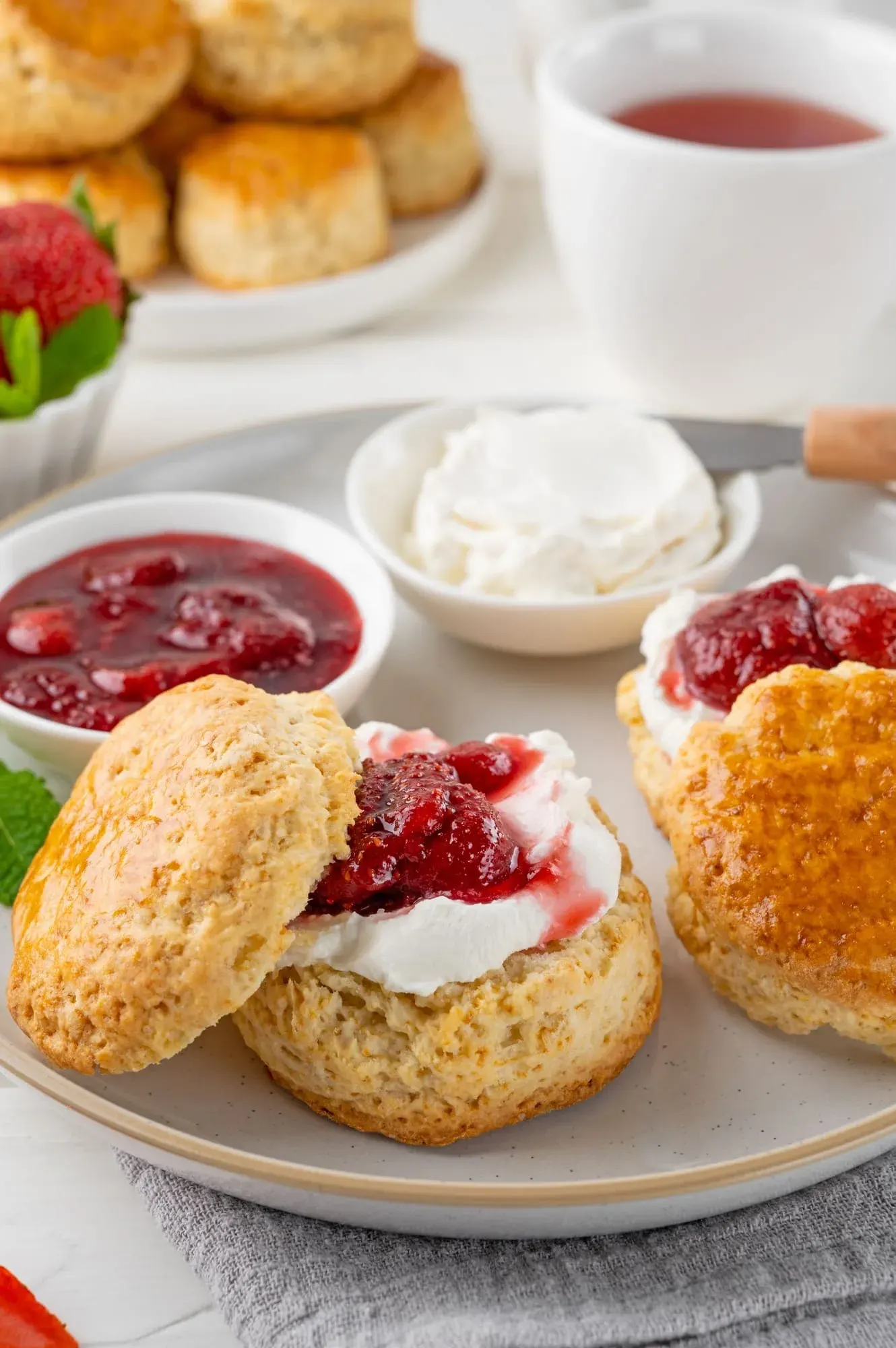
There are very few culinary topics that can spark such fierce loyalty and cross-border controversy as the question of how to properly assemble a cream tea. In the red corner: Cornwall. In the white corner: Devon. And in between is a humble scone, split down the middle and at the centre of a national debate. Do you dollop the jam first, like any self-respecting Cornish person? Or do you pile on the cream first, in true Devonshire fashion?
In this article, we’re digging into the history, food science, etiquette, and modern opinions behind the great cream tea divide, and whether the jam-first method truly settles the debate in Cornwall’s favour.
The Origins of Cream Tea: Clotted Roots
The idea of combining bread (or scones), cream, and jam isn’t just a modern invention designed to please tourists, and according to local historians, the earliest known version of the cream tea dates back to the 11th century when monks at Tavistock Abbey in Devon are said to have served bread with clotted cream and preserves to workers restoring the abbey after it was plundered by Vikings.1
While that might give Devon the edge in the origin stories stakes2 (although with a fair amount of bias from the Devon side of the border), Cornwall’s relationship with dairy (particularly clotted cream) is equally deep-rooted because the county’s rich pastures and mild Atlantic climate made it ideal for dairy farming, and clotted cream was a staple long before tourists arrived. Some even argue that while the monks of Devon may have started the trend, it was Cornwall that elevated it into the beloved ritual we know today.
And let’s not forget the importance of geographical indication: Cornish clotted cream was granted PDO (Protected Designation of Origin) status by the EU in 1998, meaning only cream produced in Cornwall using traditional methods can be labelled as such.3 That lends a certain credibility – and pride – to the Cornish version of the tea.
Cream or Jam First: What’s the Real Difference?
If you’re not from the South West, it might seem like a small thing, but the fact is that placing jam first or cream first actually affects the taste, texture, and structural integrity of the scone – and from a practical standpoint, spreading jam on a freshly halved scone is easier than attempting to smooth it over a mound of clotted cream.
Supporters of the jam-first method argue that it allows for better distribution of flavour and honours the proper balance between sweetness and richness, and clotted cream, they say, should sit proudly on top, like a soft crown, not squashed underneath a layer of fruit preserve.
Devonians, meanwhile, argue that putting the cream on first replicates the way you’d butter toast – it’s simply the natural order of things. Plus, they suggest, the cream acts as a barrier that stops the jam from soaking into the scone and making it soggy.
Interestingly, the National Trust, which operates tearooms across the UK, doesn’t side with either county (no matter where its café might be based), and serves the jam and cream separately so the customer can choose how to have their scone. That makes sense, since there was a bit of an uproar when a National Trust ad for Lanhydrock House and Garden showed the cream going on first… in Cornwall!4
Cream or Jam First: What’s the Real Difference?
If you’re not from the South West, it might seem like a small thing, but the fact is that placing jam first or cream first actually affects the taste, texture, and structural integrity of the scone – and from a practical standpoint, spreading jam on a freshly halved scone is easier than attempting to smooth it over a mound of clotted cream.
Supporters of the jam-first method argue that it allows for better distribution of flavour and honours the proper balance between sweetness and richness, and clotted cream, they say, should sit proudly on top, like a soft crown, not squashed underneath a layer of fruit preserve.
Devonians, meanwhile, argue that putting the cream on first replicates the way you’d butter toast – it’s simply the natural order of things. Plus, they suggest, the cream acts as a barrier that stops the jam from soaking into the scone and making it soggy.
Interestingly, the National Trust, which operates tearooms across the UK, doesn’t side with either county (no matter where its café might be based), and serves the jam and cream separately so the customer can choose how to have their scone. That makes sense, since there was a bit of an uproar when a National Trust ad for Lanhydrock House and Garden showed the cream going on first… in Cornwall!4
Expert Opinions: Chefs, Scientists and the Royal Family
This wouldn’t be a proper British debate without a few celebrity endorsements, and in 2022, then-Prince Charles caused a minor stir by publishing a photograph showing him good-naturedly admonishing a young boy for serving him scones with cream spread first at the Royal Cornwall Show.5
And on top of that, renowned celebrity chef James Strawbridge has backed the Cornish method, saying that he knows exactly how to serve a cream tea – and it’s the Cornish way with no doubt.5
Meanwhile, food scientists have weighed in too. A 2024 study by the Centre for Industrial Rheology explored the ideal construction of a scone based on viscosity, and the results were that a cream-first method was found to provide a better base and easier spreading – controversial (in Cornwall, at least), perhaps, but undoubtedly scientifically correct.6
In other words, there’s not just tradition on Devon’s side – there’s evidence!
Scones Across the South West: What Locals Actually Do
You might think the whole of Cornwall is united in its jam-first stance, but it’s not always that simple; travel across the county and you’ll find pockets of quiet rebellion – cafes run by Devonians, newcomers who’ve brought cream-first habits, or people who frankly just do what they like best.
Still, most people across Devon and Cornwall pride themselves on sticking to the traditional Cornish method, and a survey by Devon Heaven found that over almost 60% of people serve cream teas with the jam underneath.7
And it’s not just Cornwall and Devon with a claim to cream tea fame. In Dorset, the scone debate is more muted, but there’s often a nod to the Cornish method – with jam typically going first – though you’re just as likely to see variations depending on the café.8 In Somerset, some tearooms add butter beneath the jam and cream (a controversial twist), and across the UK you’ll even find savoury cream teas creeping in, with cheese scones, chutneys, and cream cheese replacing the traditional elements. Even abroad, the idea has evolved: in Australia and New Zealand, a cream tea often means whipped cream instead of clotted,9 and in Japan, it’s been reimagined as a dainty, seasonal afternoon set with matcha.10
Scones Across the South West: What Locals Actually Do
You might think the whole of Cornwall is united in its jam-first stance, but it’s not always that simple; travel across the county and you’ll find pockets of quiet rebellion – cafes run by Devonians, newcomers who’ve brought cream-first habits, or people who frankly just do what they like best.
Still, most people across Devon and Cornwall pride themselves on sticking to the traditional Cornish method, and a survey by Devon Heaven found that over almost 60% of people serve cream teas with the jam underneath.7
And it’s not just Cornwall and Devon with a claim to cream tea fame. In Dorset, the scone debate is more muted, but there’s often a nod to the Cornish method – with jam typically going first – though you’re just as likely to see variations depending on the café.8 In Somerset, some tearooms add butter beneath the jam and cream (a controversial twist), and across the UK you’ll even find savoury cream teas creeping in, with cheese scones, chutneys, and cream cheese replacing the traditional elements. Even abroad, the idea has evolved: in Australia and New Zealand, a cream tea often means whipped cream instead of clotted,9 and in Japan, it’s been reimagined as a dainty, seasonal afternoon set with matcha.10
Cream Tea Controversy Online: The Jam Hits the Fan
This debate doesn’t just play out over the counter at tea rooms, of course; it’s alive and well on social media, too. Every few months, a celebrity, brand or clueless café somewhere north of Bristol will post a cream tea picture, blissfully unaware of the fury about to land in their comments section.
The conversation’s become so recognisable that it’s often used in marketing. Local cafés and hotels play up the rivalry to drive engagement – polls on Instagram stories, cream tea giveaways, even ‘duelling cream teas’ where guests are served one of each and asked to vote. While light-hearted, it shows how deeply the ritual is tied to regional identity.
Even hashtags have become a battlefield. #JamFirst posts tend to outnumber #CreamFirst by nearly 3 to 1 on Instagram, at least among Cornish users, and Visit Cornwall even has a sly dig at its neighbouring county on its website, reminding people who want to enjoy a cream tea to spread the jam first and saying ‘don’t let the Devon method fool you’!11
Tourism, Identity and the Business of Scones
Behind the jam-and-cream jokes lies a real economic angle – Cornwall receives over four million visitors a year, and many of them will order at least one cream tea during their stay, with estimates being in the region of 100,000 cream teas eaten every year.13 That makes it a powerful ambassador for Cornish culture – a sweet, buttery symbol of everything holidaymakers imagine when they picture a coastal escape: comfort, indulgence, and tradition.
Tearooms and cafés in places like Padstow, Fowey, St Ives and Newquay often build part of their branding around the cream tea, and you’ll see it featured on chalkboard signs, used in loyalty promotions, and increasingly tied to local ingredients. Many now specify that they serve Cornish clotted cream with local strawberry jam and handmade scones, reinforcing both quality and heritage in one plate.
There’s also a rising trend of offering cream tea gift boxes for mail order, particularly after the COVID-19 lockdowns, when demand for a little bit of Cornwall by post exploded.14 These too are advertised as jam first, sometimes with instructions printed right on the lid, as if to ward off any accidental Devoning.
This deep tie between food and identity really matters because in a region where traditional industries like fishing and mining have declined, culture and tourism help keep small businesses afloat, so the cream tea isn’t just nostalgic; it’s a thriving part of Cornwall’s rural economy and it’s treated with all the respect it deserves.
Settling the Debate? Maybe Not – But That’s the Point
It might sound like light-hearted rivalry, but for many people in the South West, this is no joke; the cream tea is part of the region’s cultural identity, and from tearooms on Bodmin Moor to cafés overlooking the South Hams coast, the cream tea debate runs deeper than jam jars and ramekins; it touches on questions of tradition, authenticity, and even tourism marketing. It is, afterall, also one of the many elements Cornwall is famous for.
So, is the debate really settled? Technically, no – not while there are people in Devon making their case. But from a Cornish perspective, the answer is clear. The jam goes first, always has, and always will. It’s not about one-upmanship, it’s about preserving something rooted in place and memory – it’s what your gran served you on a rainy Sunday, it’s what you ate at the village fête, it’s what your local café serves with pride…
And in a world where food trends come and go, there’s something oddly comforting about a debate that never really ends. Because it means people still care. Besides, if the worst thing we disagree on is the order in which we construct our cream tea, well, we’re doing all right.
Article Sources
- Team, E. (2024). The History Behind The Tradition of Cream Tea: Who Actually Invented It And How Did it Get So Popular? [online] Cookist.com. Available at: https://www.cookist.com/the-history-behind-the-tradition-of-cream-team-who-actually-invented-it-and-how-did-it-get-so-popular Cookist.com[↩]
- Tavistockguildhall.org. (2025). History of Cream Teas. [online] Available at: https://tavistockguildhall.org/news-details/born-in-tavistock-the-history-of-the-devonshire-cream-tea/22/0/0 Tavistock Guildhall[↩]
- Department for Environment, F.& R.A. (2021) Cornish clotted cream, GOV.UK. Available at: https://www.gov.uk/protected-food-drink-names/cornish-clotted-cream GOV UK[↩]
- Country Living (no date) The National Trust accidentally sparked a heated (if a little light-hearted) debate on Mother’s Day. Available at: https://www.countryliving.com/uk/create/food-and-drink/news/a3478/national-trust-cream-tea-advert-cornwall-angry Country Living[↩]
- Hards, S. (2022) Prince Charles has joined the Cream Tea debate and Cornwall has lost it, Cornwall Live. Available at: https://www.cornwalllive.com/news/cornwall-news/prince-charles-joins-cream-tea-1653664 Cornwall Live[↩]
- Priestley, S. (2023) A tale of two cream teas: Why the British are still arguing over their scones, Serious Eats. Available at: https://www.seriouseats.com/british-cream-tea-correct-order-5225936 Serious Eats[↩]
- Pochin, C. (2024) Scientists have finally revealed if you should put cream or jam first on scones, Metro. Available at: https://metro.co.uk/2024/08/19/scientists-finally-revealed-whether-put-cream-jam-first-scones-21447575 Metro[↩]
- Cream tea poll results – did it backfire? (no date) Devon Heaven. Available at: https://www.devonheaven.co.uk/blogs/news/cream-tea-poll-results Devon Heaven[↩]
- Dimmer, M. (2023). Cream Tea Etiquette – The Dorset Hand Made Food Company. [online] The Dorset Hand Made Food Company. Available at: https://thedorsethandmadefoodcompany.co.uk/cream-tea-etiquette/ The Dorset Handmade Food Company[↩]
- Annette (2011). Clotted Cream – why? how? [online] la vie boheme travel. Available at: https://laviebohemetravel.wordpress.com/2011/03/14/clotted-cream-why-how/ La Vie Boheme Travel[↩]
- Kozmic, A. (2015) Matcha scones with yuzu and mango – A Matter of Taste. [online] A Matter of Taste. Available at: https://www.amatteroftaste.me/matcha-scones/ A Matter of Taste[↩]
- Cornwall’s Food & Drink Heritage (no date) Visit Cornwall. Available at: https://www.visitcornwall.com/things-to-do/food-and-drink/cornwall-s-food-and-drink-heritage Visit Cornwall
- Loop South West (2023) Cornwall’s clotted cream sales soar as visitors flock to the region, Loop South West. Available at: https://www.loopsouthwest.co.uk/home/2023/cornwalls-clotted-cream-sales-soar-as-visitors-flock-to-the-region Loop Southwest
- Classic Cornish Hampers by Post: Free Delivery (no date) The Cornish Company. Available at: https://thecornishcompany.com/collections/cornish-hampers The Cornish Company
Frequently Asked Questions
A Cornish cream tea is a traditional British treat featuring freshly baked scones served with clotted cream, jam (usually strawberry), and a pot of tea. It’s a beloved ritual in Cornwall and a must-try for visitors.
The main difference is in how the scone is topped:
- Cornish style: Jam first, then clotted cream.
- Devonshire style: Cream first, then jam.
Both are delicious, but locals are proud of their regional traditions!
In Cornwall, the traditional way is jam first, cream second. This order is said to let the rich cream rest atop the fruity jam, creating the perfect balance of flavors.
Technically, both orders are correct—though in Cornwall, jam-first is king. Ultimately, the “right” way is the one that makes you happiest!
Strawberry jam is the classic choice, but raspberry or other fruit preserves are also commonly enjoyed.
Absolutely! Use fresh scones, high-quality clotted cream, and your favorite jam. Warm the scones slightly, and follow the Cornish method for authenticity: jam first, cream second.
Cornish scones are often lighter, slightly sweeter, and larger than standard scones, making them perfect for topping with generous amounts of jam and cream.
Visit Cornwall’s tea rooms, coastal cafes, or hotels for the real deal. Many places proudly serve scones jam-first with local clotted cream, honoring the Cornish tradition.
Not really—but many enthusiasts insist that the jam-first method prevents the cream from melting too quickly into the scone, keeping each bite luxuriously creamy.
It’s mostly good-natured rivalry—but locals take pride in their jam-first tradition. Expect a playful but passionate response if you order it “wrong”!
Written by
Lisamarie is a writer and researcher with a long-standing love for Cornwall – its towns, coastlines, folklore, and everything in between. Most of her work involves blogging and articles, often focused on places and people, which pairs neatly with her fiction writing since both sides of her work let her balance research with imagination (and indulge a fondness for obscure facts). She lives with her husband, daughter, and a cat called Cheryl in a cottage in the Kent countryside, where she writes, paints, and watches horror films.
35 articles published on Cornwall.co.uk
Read more from Lisamarie Lamb →




Comments
No comments yet — be the first to share your thoughts.
Leave a comment
Your email won’t be published. Comments are checked before they appear.