

9 articles
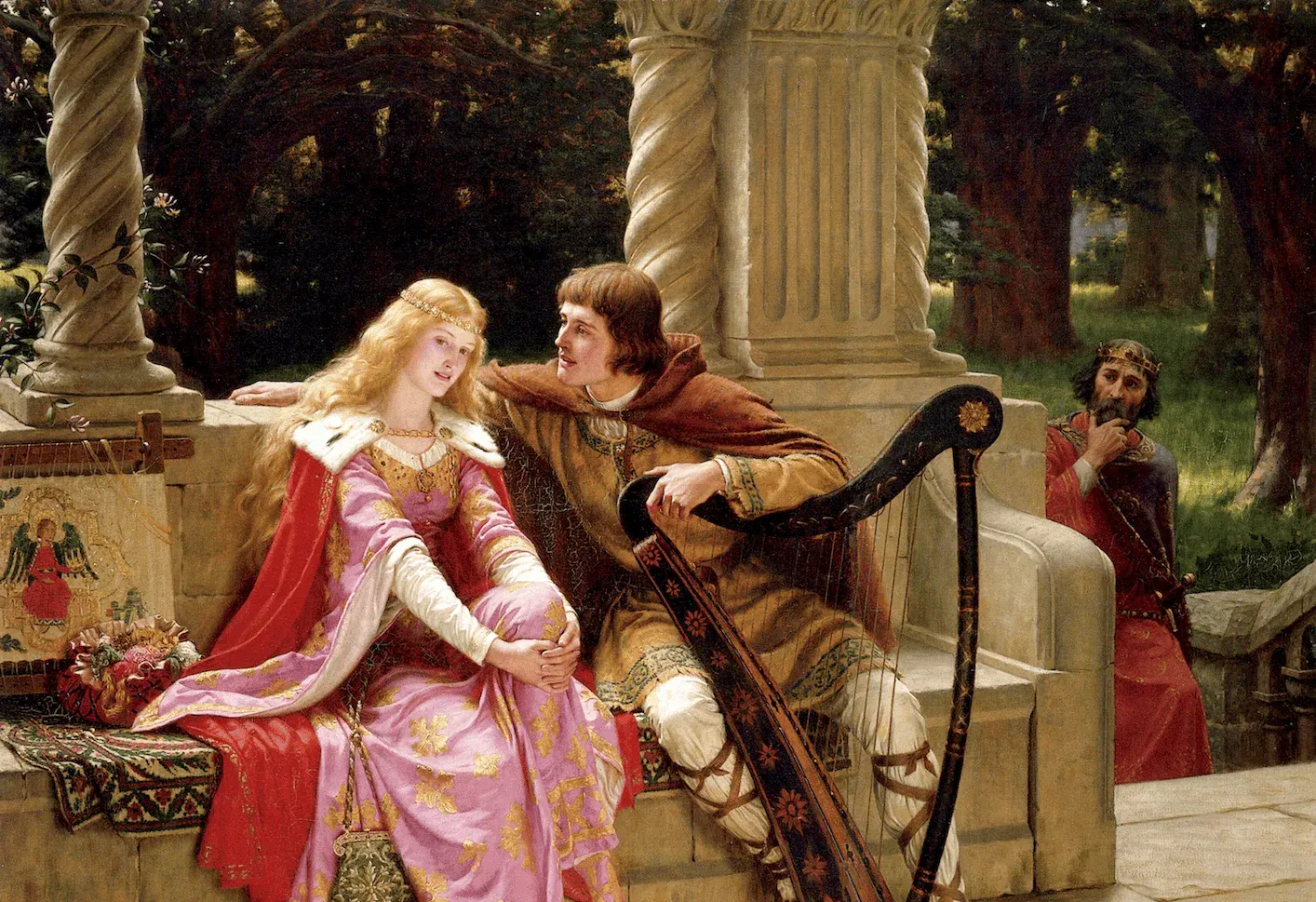
One of the most famous love stories ever told concerns the romance between Sir Tristram and Lady Iseult. Just like in the tale of Romeo and Juliet, their romance was doomed to end in tragedy. Romeo and Juliet’s story was set in Italy, but Tristram and Iseult’s tale took place right here in Cornwall.
Arthurian Cornwall
Several stories concerning King Arthur and his knights are set in Cornwall. Indeed, the legendary king is said to have been born at Tintagel Castle on the north Cornish coast.1
These tales became very popular in medieval times, not only in England but across Europe. Arthurian literature was known at the time as the Matter of Britain and considered to be amongst the worthiest literature in European culture.
The story of Sir Tristram and Lady Iseult (alternatively the tale of Tristan and Isolde or Sir Tristrem and Isolt/Yseult, depending on the version of the story you read), has proven to be one of the most popular and enduring of all Arthurian tales.
Did you know? The Cornish version of Iseult’s name is Eselde or, less commonly, Ysella.
History of the Story
Many versions of this tale were written over the years. By the end of the Middle Ages, numerous versions existed. The two earliest surviving copies date back to the mid-12th century.
One was written by a Norman or Breton poet known as Béroul. Later versions that drew inspiration from Béroul’s story have become known as belonging to the ‘common tradition’. The second, was written by an Anglo-Norman known as Thomas of Britain. Stories drawing inspiration from Thomas belong to the ‘courtly tradition’. This version, in particular, inspired many medieval romances.2
From the 12th century onwards, the story was widely told throughout the courts of Europe. It was not only popular in England but also in places like France, Germany (most famously in the work of Gottfried von Strassburg), Spain, Italy and Scandinavia.2
So, what was it about this tale that made it so appealing?
The Tale of Tristram and Iseult
The tale of Tristram and Iseult that follows is constructed from the best known elements of their story as it would have been known in medieval times, drawing on several different medieval versions.3
Cornwall’s Peril
A very long time ago there was once a prince in the land of Lyonesse. His father was a noble king, and his mother was the sister of King Mark of Cornwall. He was raised by a wise tutor called Gorvenal on the advice of Merlin. By the time he came of age, everyone agreed he was a fine and noble young man, and his name was Sir Tristram of Lyonesse.
One day word reached Lyonesse that Cornwall was in peril. For many years the Kings of Ireland had extracted tribute from Cornwall. However, the burden became so great that Cornwall could no longer afford to pay. Angered, the Irish had sent a knight by the name of Morholt, the brother of their queen, to extract tribute by force of arms.
Morholt challenged the Cornish to either pay the tribute or send a champion to do battle with him. But alas Cornwall had no great champion at this time, and everyone knew Morholt was a knight of great skill and fearsome reputation.
Tristram decided to come to his uncle’s aid and travelled to Cornwall to accept Morholt’s challenge. After a fierce battle both knights were seriously injured. Morholt somehow managed to survive the journey back to Ireland, despite his grave condition. But, although the queen succeeded in extracting the fragment of Tristram’s sword from his wound, she could not save him. Distraught at her loss she swore terrible oaths of vengeance against her brother’s killer.
Tristram Goes to Ireland
Tristram was also gravely injured in the fight, and it soon became clear his wound was poisoned. No one in Cornwall could heal him and he grew weaker with each passing day. His doctors could do no more, but advised him that the only cure he might find would be in Ireland.
Knowing that he was unlikely to be welcomed in Ireland, he travelled there incognito. He was now desperately ill and taken to the Irish Princess Iseult who was Ireland’s most gifted healer. Sure enough, in time, she nursed Tristram back to health.
Tristram was most grateful and, before returning to Cornwall, he promised the Irish that he would surely seek to repay the debt he owed the princess for saving his life.
King Mark seeks Iseult’s Hand
A short time passed, and King Mark decided that he should seek a bride so that his kingdom might have an heir. After making enquiries it was arranged that he should marry Iseult of Ireland and so he sent Tristram to escort his new bride back to Cornwall.
The King of Ireland, still unaware of Tristram’s identity was happy to see him return. Even more so when Tristram repaid his debt by slaying a terrible dragon.
However, one day the queen happened upon Tristram’s sword. She soon realised that the fragment from her brother’s mortal wound was a match to a notch in the blade. Tristram was finally unmasked, and the angry queen demanded his death.
The king, however, was reluctant to take such extreme action. He refused to have Tristram killed since he had done Ireland a good service by slaying the dragon. He also agreed that Iseult’s marriage to King Mark should still go ahead. However, he told Tristram he must leave and never return to Ireland again.
The Love Potion
Before Iseult left for Cornwall, her maid servant, Brangain, was secretly given a powerful love potion by Iseult’s mother. The queen told her to serve it as a fine wine to Iseult and King Mark on their wedding night. The potion, she explained, is of such potency that the pair will fall passionately in love.
Alas, on the sea voyage from Ireland to Cornwall, Tristram and Iseult discovered the potion hidden away. They wonder why Brangain had concealed the best wine from them and decide to try it. They drank the wine together and, sure enough, fell passionately in love with each other.
A Secret Love
Tristram and Iseult, though in love, felt honour bound to fulfil their pledges. Iseult would marry Mark and Tristram felt compelled to remain loyal to his uncle. But the power of their love was undeniable and the two became lovers, meeting in secret behind Mark’s back.
Mark’s barons, jealous of Tristram’s favoured position, and hearing rumours of their affair, sought to find a way to expose the couple. They set the dwarf, Frocin, to spy for them.
Frocin soon learnt the pair often met by a particular tree. Frocin informed Mark and, although the king did not believe him, he hid nearby to observe the lovers for himself.
Luckily, Tristram and Iseult spied Mark hiding and behaved impeccably. Mark was re-assured and Frocin forced to flee the court for his rumour mongering.
Exposed
Frocin, however, did not give up. One day he observed that Tristram was injured whilst hunting wild boar. Seeing an opportunity, he sneaked into Iseult’s bed chambers and sprinkled flour upon her bed.
That night Tristram visited Iseult and the pair made love. Having been tipped off by Frocin, the king and his guards entered the chamber the next day. Seeing the blood stains, the king finally understood that Tristram and Iseult had shared a bed.
In a blind rage Mark ordered Tristram’s arrest and sentenced him to death. As for Iseult, he gave her to a leper colony to serve as their whore.
Escape to the Wild
Tristram was imprisoned in a tower, awaiting execution. All seemed lost but driven by his love, Tristram somehow broke his bonds and leapt from a high window down onto a beach before making good his escape.
Tristram rescued Iseult and the couple sought refuge in the wild forest of Morrois. For a time, they lived together happily, surviving on Tristram’s skill as a huntsman.
However, eventually the couple were discovered by a forester who reported their whereabouts to King Mark. The king’s anger had abated somewhat by this time, but he nevertheless decided to travel to the forest to see the couple for himself.
When Mark discovered them, he found them asleep but fully clothed and with Tristram’s sword between them. Perhaps, he wondered, they had lived a chaste life in the forest after all. Perhaps, he wondered, Iseult had always been faithful to him. He therefore decided to leave them undisturbed.
Reconciliation
Tristram and Iseult were indeed conflicted. The thought of ever being parted filled them with pain. However, their sense of honour and piety yearned for repentance. On the advice of a hermit named Ogrin, Tristram wrote to Mark seeking reconciliation.
By then, Mark’s wrath had time to relent and so he agreed to take back Iseult if she would swear oaths on holy relics that she had remained faithful to him. As regards Tristram, he could not wholly forgive him but commuted his sentence to exile rather than death.
Of course there was a problem. Iseult had not been faithful to Mark, so how could she swear such an oath?
To get around this problem the couple came up with an ingenious plan. Tristram disguised himself as a leper and accompanied Iseult to meet the king beside a river. Under the pretext of keeping her dress from getting wet she forded the river straddled on Tristram’s shoulders.
When she reached the other side, she swore an oath upon the relics, saying that aside from King Mark and the leper upon whose shoulders she crossed the river, no man had ever been between her legs.
Reassured, Mark accepted Iseult back as his queen.
Did you know? It is uncertain where Tristram was supposed to have made his miraculous leap to freedom but the most likely location is Tintagel Castle.
Iseult of the White Hand
Iseult returned to Cornwall, resigned to a loveless marriage. Tristram went into exile with a heavy heart, knowing that he could never be with his true love.
After a time Tristram married another woman known as Iseult of the White Hand or Iseult of Brittany. He did so because he wanted to know whether his own Iseult could ever find happiness with another. Could either of them ever be happy with another? But, of course, it was not the same.
Later Tristram joined the Knights of the Round Table and performed many great deeds. In time he even came to rival Lancelot.
One day, whilst travelling, Tristram and his companion were attacked by eight others. All were slain save Tristram who, being such a skilled knight, overcame his foes despite their advantage in numbers.
However, it soon became clear that Tristram’s wound was poisoned and, as the days passed, his condition deteriorated.
Death of the Lovers
Recalling the healing talents of his fair Iseult, he asked his retainer Gorvenal to travel to Cornwall to ask if Iseult would return heal him. He instructed Gorvenal that he should return with a white sail if Iseult was with him. If, however, Iseult refused to come, he should raise a black sail.
Gorvenal travelled to Cornwall and, without hesitation, Iseult agreed to help. And so, they returned, raising a white sail.
As the ship approached, Tristram asked Iseult of the White Hand to tell him whether the sail was white or black. She saw that it was white and, gripped by fear and jealousy, she lied and told Tristram the sail was black.
On hearing this Tristram died of a broken heart. Iseult, on learning that Tristram was dead, was struck down with such pain that she also died of a broken heart.
The two were buried in the same graveyard, but King Mark insisted their graves were set far apart from each other. Nevertheless, as the years passed, two trees grew up, one from each grave. In time their branches reached out across the graveyard and intertwined.
Finally, Tristram and Iseult were together.
The World of Tristram and Iseult
If the tale of Tristram and Iseult’s doomed love intrigues you, you might wish to visit some of the places in Cornwall connected with their story.
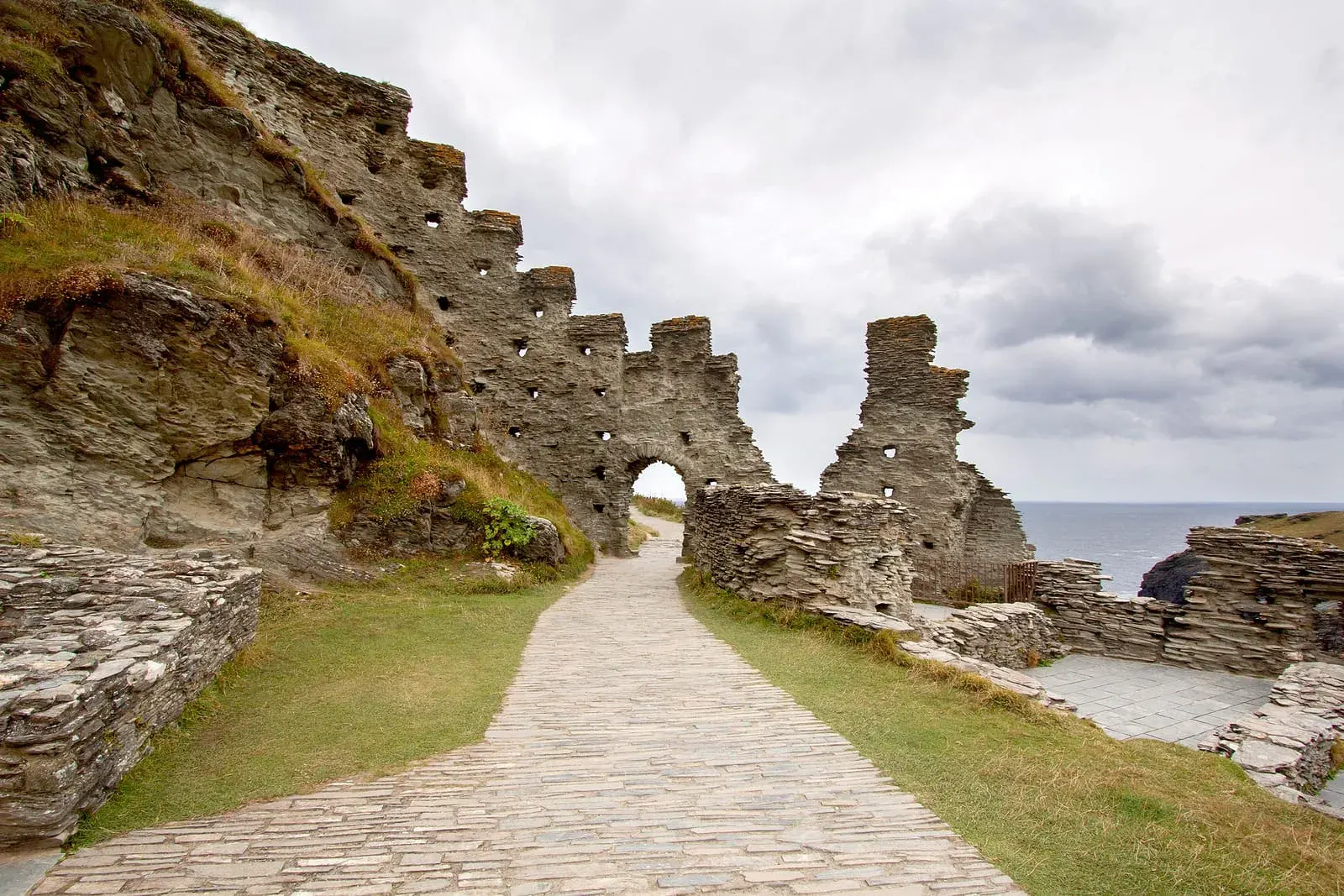
King Mark’s court was located at Tintagel in virtually all versions of the story, including Malory’s late medieval epic.3 Archaeological work has shown that there was a significant settlement at Tintagel at the time King Arthur may have lived.
Another location associated with Tristram and Iseult is Roche Rock near St Austell.5
Tintagel Castle:
- Grid Reference: SX 05225 89008
- What3words: ///rollover.gangway.panicking
Roche Rock:
- Grid Reference: SW 99111 59617
- What3words: ///pixel.cucumber.trailing
A True Story?
There is evidence to suggest that the tale of Tristram and Iseult may have been based on a true story, dating all the way back to Cornwall’s dim and distant Celtic roots!
Firstly, there is an old stone monument near Fowey called the Tristan Stone.6 It may date back to the 6th century, the time when an historic Arthur was supposed to have lived and bears the following inscription:
“Here lies Drustan, son of Cynvawr” 7
The stone is near Castle Dore, a hill fort that was occupied as a chieftain’s residence at this time. The Breton monk, Wrmonoc, writing in the 9th century, believed that Cynvawr was king of Cornwall during the 6th century. Cynvawr may be the original name for the character later known as King Mark.
Could this Drustan have been the Tristram of later medieval stories? In a fragment of an old poem written in Wales before 1100, a very similar name – ‘Drystan’ – is used. Was this another early reference to Tristram?8
Perhaps, then, the tragic tale of Tristram and Iseult is more than just an old myth.
The Tristan Stone:
- Grid reference: SX 11231 52117
- What3words: ///contain.broadens.zones
Castle Dore:
- Grid Reference: SX 10344 54816
- What3words: ///spared.sprouting.inserting
Tristram and Iseult Today
The original medieval stories continued to inspire new versions of the tale ever since. This includes famous poems by Tennyson, Swinburne and Matthew Arnold and an opera by Richard Wagner (Tristan und Isolde). Indeed, there is even a children’s novel (Tristan and Iseult).
Their tale was remade into a film as recently as 2006 and has inspired modern young adult fiction (Izzy + Tristan by Hannah Harrison) and fantasy literature (Black Waves by Kristina Perez).
Just like Romeo and Juliet, Tristram and Iseult’s love story continues to have enduring appeal centuries after it was first told.
Article Sources
- Monmouth, G of. (1966). The History of the Kings of Britain. London: Penguin Classics[↩]
- Lupack, A. (2005). Guide to Arthurian Literature and Legend. Oxford: Oxford University Press[↩]
- Malory, T. (2004). Le Morte D’Arthur, Vols I & II. London: Penguin Classics[↩]
- Malory, T. (2004). Le Morte D’Arthur, Vols II. London: Penguin Classics[↩]
- English Heritage. (n.d.). Tintagel Castle: History and Legend. [online] Available at: https://www.english-heritage.org.uk/visit/places/tintagel-castle/history-and-legend English Heritage[↩]
- Wikipedia Contributors (2019). Roche. [online] Wikipedia. Available at: https://en.wikipedia.org/wiki/Roche Wikipedia Contributors[↩]
- Historic England (2025). The Tristan Stone, early Christian memorial stone and wayside cross, 75m north of Polscoe, Fowey – 1016287 | Historic England. [online] Available at: https://historicengland.org.uk/listing/the-list/list-entry/1016287?section=official-list-entry Historic England[↩]
- Lupack, A. (2005, quoted on p.171). Guide to Arthurian Literature and Legend. Oxford: Oxford University Press[↩]
- Lupack, A. (2005). Guide to Arthurian Literature and Legend. Oxford: Oxford University Press
Frequently Asked Questions
Tristram and Iseult is a story from Arthurian folklore, the earliest surviving versions date back to the 12th century. It is a tale of doomed love between Sir Tristram of the Round Table and Iseult, the wife of Tristram’s uncle, King Mark of Cornwall.
Tristram and Iseult were lovers in Arthurian lore. Although Iseult marries Tristram’s uncle, King Mark of Cornwall, the pair fall madly in love after accidentally sharing a love potion. Traditionally, their story ends in tragedy, and the two lovers die.
In some versions of the story there are two characters called Iseult! Tristram falls in love with Iseult the Blonde, but since she is married to his uncle the pair cannot be wed. Instead Tristram marries Iseult of the White Hand hoping he will forget his true love.
The origins of the story are uncertain, but the earliest surviving versions are poems, dating back to the 12th century. One was written by a Norman or Breton poet known as Béroul. The other by an Anglo-Norman known only as Thomas.
The Knights of the Round Table were a legendary order of knights, sworn to the service of King Arthur. They were so named because they sat around a round table whenever they met in council with the king.
The legend of Tristram and Iseult is a tale of doomed love. Tristram was sent by his uncle, King Mark, to bring Mark’s bride-to-be (Iseult) to Cornwall. However, Tristram and Iseult accidentally drank a love potion and fell passionately in love with each other on the journey.
Tristram and Iseult fall in love with each other because they accidentally share a powerful love potion. This is a problem because Iseult must marry King Mark, Tristram’s uncle. The couple nevertheless embark on a passionate but doomed love affair.
Tristram and Iseult are the legendary lovers of a medieval romance, also known as Tristan and Isolde, whose tragic love story is central to Arthurian literature.
In most versions, Tristram dies from a poisoned wound, believing Iseult has abandoned him
Yes, the legend exists in multiple medieval versions, including French, German, and English retellings.
There is no single author; the legend evolved through oral tradition and medieval poets like Béroul, Thomas of Britain, and Gottfried von Strassburg.
Yes, Tristram and Iseult is often compared to Romeo and Juliet as an early example of tragic, forbidden love.
Written by
Paul Watts is a local writer based in Launceston with a keen interest in history and folklore, having studied A History of Folklore at Oxford University. He is the author of Myths and Legends of the Medieval World (Pen & Sword Books) as well as a leading medieval history blog (named a ‘Top blog’ by Feedspot in 2025)
9 articles published on Cornwall.co.uk
Read more from Paul Watts →

Comments
No comments yet — be the first to share your thoughts.
Leave a comment
Your email won’t be published. Comments are checked before they appear.