

9 articles
Saint Piran is the patron saint of Cornwall and one of the most recognisable symbols of Cornish identity. He is the inspiration behind Cornwall’s black-and-white flag and famous for legends such as the miracle of the millstone, and the discovery of tin. His story blends history, myth, and Celtic Christianity. His saint’s day, on 5th March, is widely celebrated across Cornwall to this day. This guide explains who St Piran was, and why he remains so central to Cornish culture today.
Who Was St Piran? From Irish Exile to Cornish Legend
The legend of St Piran is well known in Cornwall but perhaps less well known outside the county:
- St Piran was originally said to have been an Irish Bishop, living in the 5th century AD.
- Some believe he was the Irish saint known as Saint Ciarán of Saighir.1
- He was exiled from Ireland by heathen kings.
- He arrived in Cornwall at Penhale Sands beach in the parish of Perranzabuloe.2
- He was said to have lived for a miraculous 206 years!2
- Traditional stories credit him with discovering how to refine tin.2
- He is the patron saint of Cornwall and tin miners.
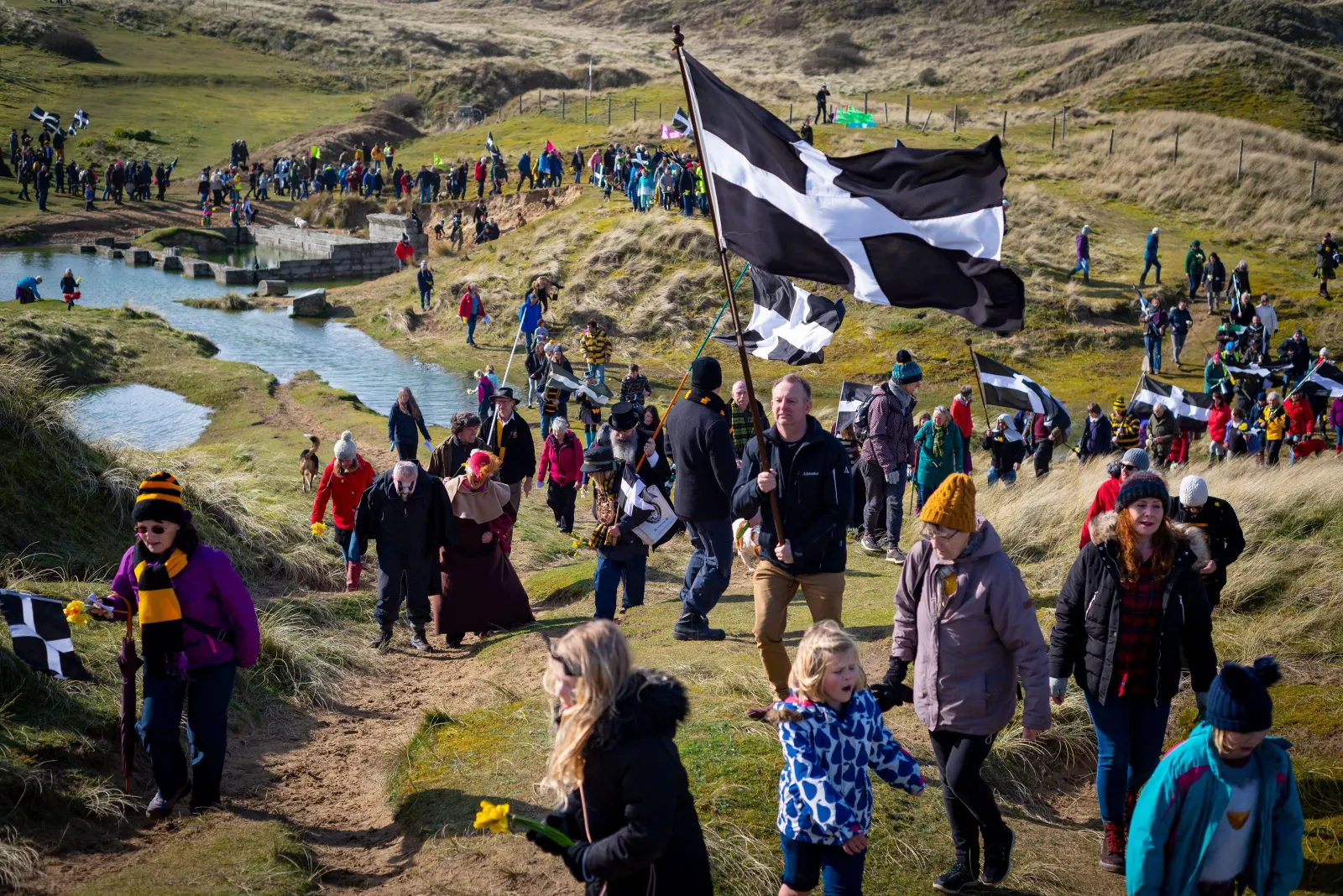
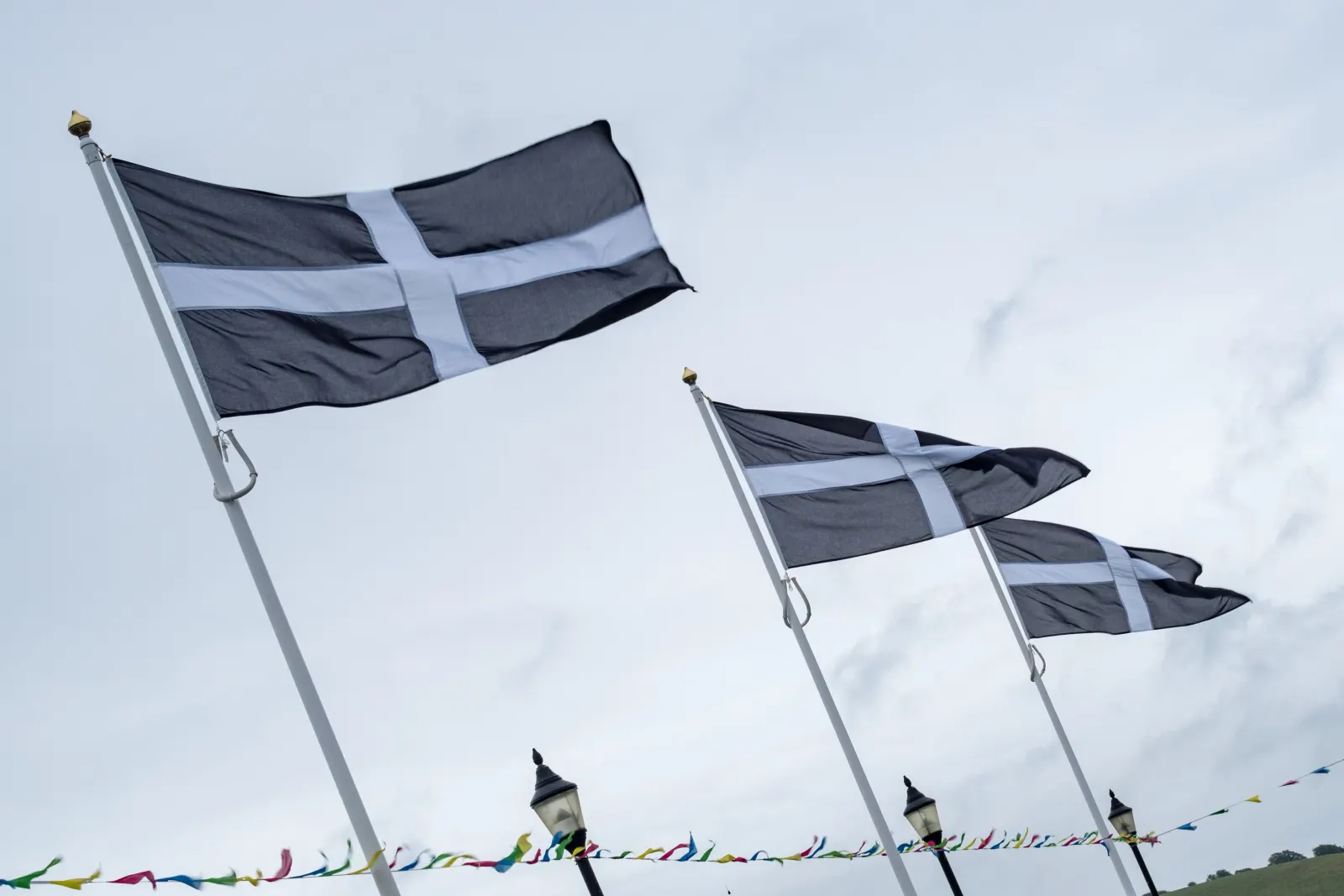
- St Piran’s Flag (white cross on a black background) is the national flag of Cornwall.
- St Piran’s Day is celebrated on 5th March.
The Legend of St Piran: Myths and Miracles
The legend of St Piran goes back a long way. When the folklorist, Robert Hunt compiled his collection of Cornish folk tales in 1865, St Piran’s story was already an old one.2
St Piran Legend: The story of the Miracle of the Millstone (Explained)
According to one legend, St Piran’s early life was spent in Ireland. Hunt gives the date of his birth as 352AD.
St Piran performed several miracles in Ireland, including feeding armies and resurrecting dead warriors. Despite this, the heathen Irish kings took a dislike to him and condemned him to be cast off a cliff into the Atlantic with a millstone tied around his neck.
However, when St Piran was cast off the cliff a holy light descended. The saint sat serenely on the millstone as it floated gently down to the sea. Many who witnessed this miracle converted to Christianity on the spot.
The story goes that the saint floated on this stone all the way to Cornwall. There he washed up ashore on a beach near Perranporth on the 5th March (now his saint’s day). There he settled to live a pious life until his death, surviving to the ripe (not to say miraculous) old age of 206!
The Legend of how St Piran Discovered Tin
The legend of how St Piran discovered how to refine tin is a core part of his Cornish identity. The story goes that the discovery was made when St Piran collected some local rocks to use as hearthstones for his fireplace. The heat from the fire was so fierce that melted tin began seeping from one of the stones. And so, just like that, St Piran discovered how to refine tin from natural ore.
This discovery brought such wealth to the Cornish that they decided to celebrate it on St Piran’s Day. Unsurprisingly, St Piran became the patron saint of tin miners.
The History of St Piran
But how many of these popular legends and stories are true? Who was the historic St Piran?
In the 14th Century, John de Grandison, Bishop of Exeter, noted that very little had been written about Cornish saints like Piran. So, he commissioned research to rectify the situation. The material he collected represented an early attempt to properly document St Piran’s story although it no longer survives in its complete original form.3
St Piran Biography: Historical Accounts
The three earliest surviving historical sources for St Piran’s life are:3
The Gotha manuscript, discovered in an archive in Germany in 1937. Written in the 12th or 13th century, it contains details of several early Celtic Christian saints including St Piran.
The ‘Life of St Piran’ was written by John of Tynemouth in the 14th century. John may have based his account on the Gotha manuscript and/or John de Grandison’s material.
Wynkyn de Worde published an account in 1516. It was likely based at least in part on Tynemouth’s work.
Accounts of saint’s lives such as these can be notoriously unreliable, often embellished with myths and tales of miracles that stretch credibility. However, they are all we have.
St Piran History: The Life of St Piran in the Gotha Manuscript
The Gotha manuscript is the earliest surviving account of St Piran’s life. The following details of St Piran’s life can be gleaned from this account:3
- Piran’s Latin name is Keranus.
- He was born in Ossory, Leinster in Ireland.
- After 30 years as a lay preacher, he travelled to Rome to study.
- He was appointed as a bishop.
- After 200 years he sailed to Cornwall to establish a ministry there.
- He died on 5th March 480.
Note that this early version also includes the fantastic claim to great longevity. This was included to provide the saint with enhanced gravitas, in emulation of similar claims made for biblical characters like Adam and Moses.
Was St Piran and St Ciarán of Saigir the Same Person?
It has been suggested that details of the life of St Piran were copied from accounts of the life of an Irish saint, Ciarán of Saigir, who lived at the same time.
Is it therefore possible we’re dealing with one and the same person? One problem with this is that there is no record of Ciarán ever visiting Cornwall in Irish sources. Ciarán did, however, leave Ireland for a period of thirty years. [1] There is also archaeological evidence of Irish colonization in Cornwall at around this time, so an Irish connection is entirely possible.4 However, it is not possible to demonstrate that Piran and Ciarán were the same person.
A more sceptical theory for the connection is that little information survived relating to Piran’s life by the 13th century. Medieval attempts to reconstruct an account of his life by people like de Grandison and Tynemouth may therefore have borrowed from the Life of St Ciarán to ‘fill in gaps’.5
Did St Piran Really Discover Tin?
One thing we can be sure of is that the historic St Piran had nothing to do with the origins of Cornish tin mining. Tin production was thriving in Cornwall long before St Piran’s time. A shipwreck off the coast of Israel was found to contain tin mined in Cornwall dated as long ago as 1000 BC.3
Who was the Real St Piran?
So, what can we reasonably say about the historic St Piran? Based on the fragmentary surviving evidence, we might postulate:
- St Piran lived sometime between the mid-5th century and the early 6th century.
- He came to Cornwall from Ireland and may also be remembered as an Irish saint.
- He was associated with Perranporth and appears to have established a small church there.
- He became associated with tin mining (perhaps because his ministry was popular with local tinners).
St Piran’s Oratory: Cornwall’s Oldest Christian Site
If St Piran resided in the Perranporth area, as these stories claim, we might wonder whether there is any archaeological evidence of his presence in the region?
St Piran’s Oratory at Penhale Sands
As it happens a small early medieval oratory church is located just to the north of Perranporth, at Penhale Sands. Excavations at the site have revealed that the oratory was present here since around the 7th century and remained in use throughout the Middle Ages.
The original stone structure can only be dated back as far as the 7th century. However, any earlier church in the area (dating back to St Piran’s time) would have been made of wood. Any 5th or 6th century wooden structure would be difficult to locate in the archaeological record. The surviving oratory is, nevertheless, the oldest Christian site in Cornwall.7
The Archaeology of St Piran’s Oratory
The oratory fell into disuse and was eventually buried by the passage of time. However, it was excavated in Victorian times and has undergone further archaeological work and preservation measures since:7
- 1830s/1840s: the oratory site was excavated, revealing the building for the first time in several centuries.
- 1910: a concrete shell was placed around the site to protect it.
- 1980: the shell was demolished, and the chapel reburied to help preserve it. Evidence of an associated early medieval cemetery was uncovered at this time.
- 2014: the site was uncovered again, and a concrete surrounding wall was constructed to protect it.8
St Piran’s Oratory: You can visit St Piran’s Oratory today and directly experience this ancient connection to Cornwall’s most beloved saint.
- Grid Reference: SW 76839 56393
- What3words: ///hack.lyricism.wicked
The Flag of St Piran and its Symbolism
St Piran’s flag consists of a white cross on a black field and is famous for having being adopted as the Cornish flag. But what does the St Piran’s cross mean? Traditionally it is said to symbolise St Piran’s discovery of tin (the white cross represents smelted tin; the black background represents unrefined ore).2
But who created the St Piran flag? The answer is that we can’t be sure. The earliest specific reference to it appears in Davis Gilbert’s Parochial History of Cornwall of 1865 but it may well be older.4
The flag bears a similarity to the Breton Kroaz Du (a black cross on a white field). Since Brittany and Cornwall share a close Celtic connection, both flags may date back to a similar time. The Kroaz Du probably dates to the 13th century.5 It is therefore just possible that St Piran’s flag is as old.
St Piran’s Day Cornwall: Celebrations and Modern Traditions
The Origins of St Piran’s Day
St Piran’s Day is celebrated on March 5th. According to folklore from Victorian times this day was the day St Piran first arrived in Cornwall.2 However, according to the Gotha manuscript, 5th March was the day he died.3
The earliest reference to St Piran’s Day dates to the mid-18th century,6 although it may possibly well have been celebrated in earlier times.
Perrantide Celebrations
By Victorian times St Piran’s Day had assumed a boisterous character. A week of festivities referred to as Perrantide led up to the day itself. Robert Hunt observed that it often featured drunken revelry, and the expression ‘drunk as a Perraner’ was in common use.2
Modern St Piran’s Day Celebrations
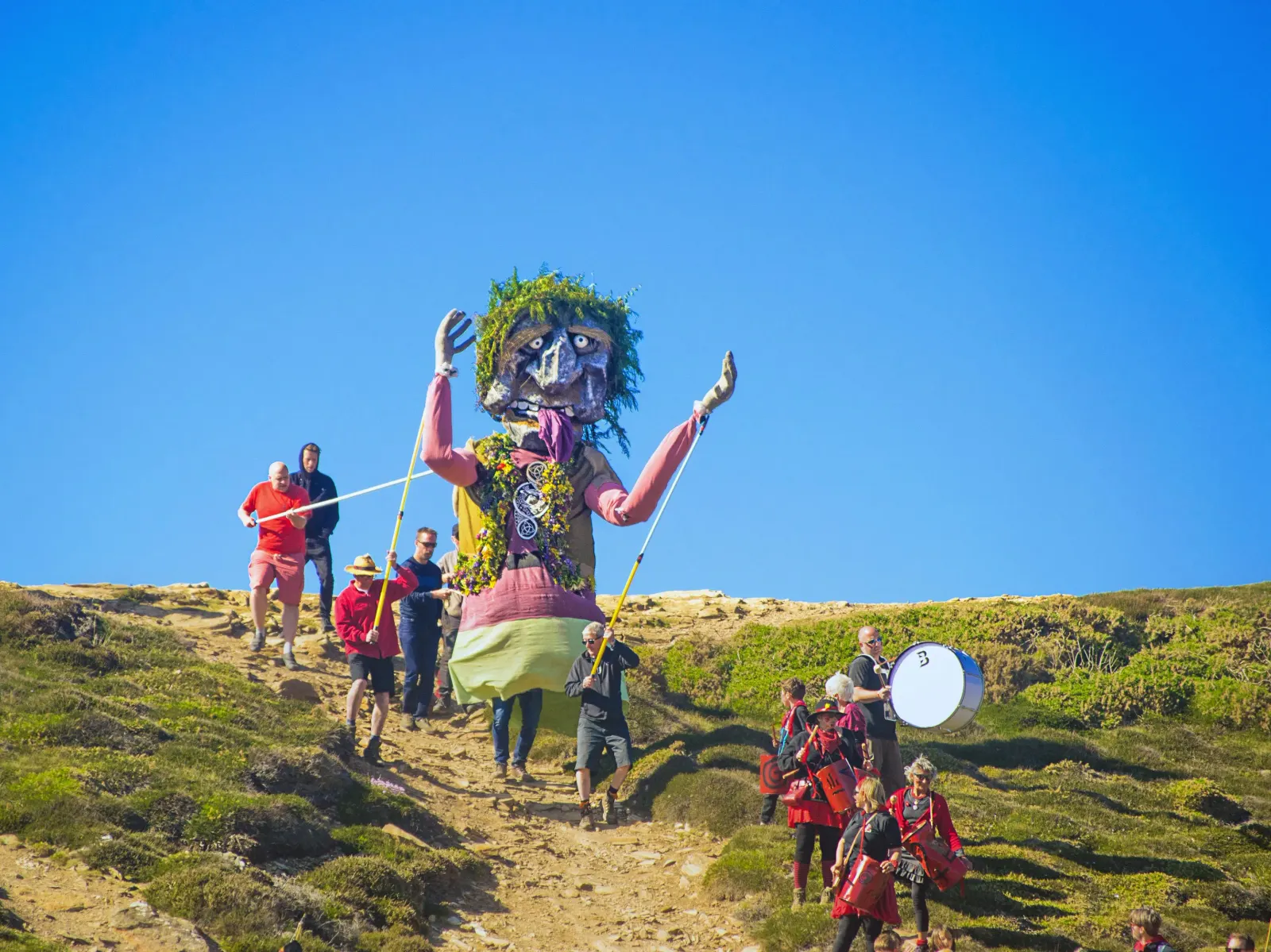
So, how is St Piran’s Day celebrated today? These days it is marked with celebrations all around Cornwall. These often include a parade (with children’s parades being especially popular). Many also feature live music, craft fairs and market stalls.
Most major Cornish towns host their own St Piran’s Day events, including Bodmin, Camborne, Falmouth, Launceston, Newquay, Padstow, Penzance, Redruth, St Austell and Truro. Perranporth, with its close connection to St Piran, often puts on a play on Perran Sands on the Sunday closest to the day.7
St Piran and Cornwall’s Mining Heritage
St Piran is the patron saint of tin miners as well as Cornwall. Along with copper mining and the fishing industry, tin mining is famed as one of the three great traditional Cornish industries.
The Cornish mining heritage and St Piran’s connection with the industry, may help explain his enduring popularity. Indeed, his saint’s day was sometimes referred to as a tinners’ (tin miners’) holiday.13
During the 19th century Cornish tin producers widely adopted a distinctive ‘lamb and flag’ stamp as a quality mark for Cornish tin. The flags depicted, naturally enough, came to be widely regarded as St Piran flags by the late 19th century.8 However, the lamb and flag symbol (displaying a cross on the flag) is actually a much older medieval heraldic symbol. It was commonly used by the Knights Templars and the cross displayed was originally supposed to be the cross of saint George.15
Geevor Tin Mine: A few old Cornish tin mining sites are preserved as UNESCO World Heritage sites today. The Geevor tin mine is the largest preserved tin mining site in the UK.
- Grid Reference: SW 37494 34440
- What3Words: ///deriving.trailing.arrow
The Enduring Spirit of St Piran: Legacy and Cultural Impact
St Piran’s Cornish identity, coupled with his flag and strong association with tin mining have helped ensure the saint’s enduring popularity. He has become a unifying symbol of Cornish identity and heritage for the people of Cornwall. There is literally nothing more Cornish than the St Piran flag.
St Piran continues to feature in contemporary Cornish art, culture and literature:
- Sculptors David Paton and Stephanie Rouget erected a 5-tonne sculpture of the saint at La Vallée des Saints in Brittany in 2018.9
- The playwright, Alan M Kent, wrote a modern play celebrating the saint and his life.10
- The poet, Neil Rhind, composed a poem about the saint in celebration of St Piran’s Day.18
- Cornwall boasts a Saint Piran UCI professional cycling team, with cyclists competing in both road racing and with mountain bikes.19
However, more than this, the saint and his flag remain an ever-present feature of Cornish life. St Piran is ultimately at the beating heart of Cornish culture, heritage and identity.
Article Sources
- Archive.org. (2025). Full text of ‘The lives of the British saints; the saints of Wales and Cornwall and such Irish saints as have dedications in Britain’. [online] Available at: https://archive.org/details/cu31924092447816/mode/2up [Accessed 18 Nov. 2025] Archive.org[↩]
- Gutenberg.org. (2019). The Project Gutenberg eBook of Popular Romances of the West of England; or, The Drolls, Traditions, and Superstitions of Old Cornwall, by Robert Hunt. [online] Available at: https://www.gutenberg.org/files/59033/59033-h/59033-h.htm [Accessed 18 Nov. 2025]. Gutenberg.org[↩]
- Kowethas Ertach Kernow – Sharing Cornwall’s historic, cultural & environmental heritage. (2025). Ertach Kernow – Is the St Piran’s story fact or legend? [online] Available at: https://www.cornwallheritage.com/ertach-kernow-blogs/st-pirans-story-fact-or-legend/ [Accessed 18 Nov. 2025] Kowethas Ertach Kernow[↩]
- Thomas, C. (1973). Irish Colonists in South West Britain. World Archaeology, [online] 5(1), pp.5–13. https://www.jstor.org/stable/i207214 Jstor.org[↩]
- Kowethas Ertach Kernow – Sharing Cornwall’s historic, cultural & environmental heritage. (2025). Ertach Kernow – Is the St Piran’s story fact or legend? [online] Available at: https://www.cornwallheritage.com/ertach-kernow-blogs/st-pirans-story-fact-or-legend/ [Accessed 18 Nov. 2025] Kowethas Ertach Kernow[↩]
- Kowethas Ertach Kernow – Sharing Cornwall’s historic, cultural & environmental heritage. (2022). Ertach Kernow – The birth of Cornish tin mining – St Piran. [online] Available at: https://www.cornwallheritage.com/ertach-kernow-blogs-2022-2023/ertach-kernow-the-birth-of-cornish-tin-mining Kowethas Ertach Kernow[↩]
- Historic England. (2025). St Piran’s Oratory and associated early medieval cemetery, Perranzabuloe – 1018955 | Historic England. [online] Available at: https://historicengland.org.uk/listing/the-list/list-entry/1018955?section=official-list-entry Historic England[↩]
- British Pilgrimage. (2023). St Piran’s Oratory, stone cross, Perranporth / Mount – British Pilgrimage Trust. [online] Available at: https://www.britishpilgrimage.org/places/st-pirans-oratory-stone-cross-perranporth-mount British Pilgrimage[↩]
- Rendle, P. (2019). Cornwall – The Mysteries of Saint Piran [Online] Available at: https://www.flaginstitute.org/pdfs/Phil%20Rendle.pdf Flag Institute[↩]
- Wikipedia Contributors (2025). Kroaz Du. Wikipedia. Accessed at: https://en.wikipedia.org/wiki/Kroaz_Du Wikipedia Contributors[↩]
- Attwater, D. (1965) The Penguin Dictionary of Saints. Penguin Books; p. 288
- Perranporth Tourist Information (2022). St Piran. [online] Perranporthinfo.co.uk. Available at: http://www.perranporthinfo.co.uk/st-piran.html [Accessed 18 Nov. 2025] Perranporth Tourist Information
- Historic UK. (n.d.). St Piran’s Day, 5th March – The Patron Saint of Cornwall. [online] Available at: https://www.historic-uk.com/CultureUK/Saint-Pirans-Day Historic UK
- Science & Society. (2025). Image of ‘lamb and flag’ cornish tin. by Science & Society Picture Library. [online] Available at: https://www.scienceandsociety.co.uk/results.asp?image=10304844 [Accessed 18 Nov. 2025] Science & Society
- Symbolikon – Visual Library of Worldwide Ancient Symbols. (2025). Agnus Dei templar Symbol – Templar Sigil – Knights Templar. [online] Available at: https://symbolikon.com/downloads/agnus-dei-templar/ [Accessed 19 Nov. 2025] Symbolikon
- Artcornwall.org. (2016). Available at: https://www.artcornwall.org/features/David_Paton/StPiran_David_Paton.htm [Accessed 18 Nov. 2025] Art Cornwall
- Kernowgoth.org. (2024). BEWNANS PERAN, A PLAY FOR PERRANTIDE by Alan M Kent – Kernow Goth. [online] Available at: https://kernowgoth.org/product/bewnans-peran-a-play-for-perrantide-by-alan-m-kent/ [Accessed 18 Nov. 2025] Kernowgoth.org
- The Society (2020). Poem A Poem Celebrating St. Piran, by Neil Rhind | Society of Classical Poets. [online] Society of Classical Poets. Available at: https://www.classicalpoets.org/2020/05/a-poem-celebrating-st-piran-by-neil-rhind/ [Accessed 18 Nov. 2025] The Society
- Saint Piran Procycling (2025). [online] Available at: https://saintpiranprocycling.com/about [Accessed 18 Nov. 2025] Saint Piran Procycling
Frequently Asked Questions
St Piran was an early medieval saint, who came to Cornwall from Ireland. Legends credit him with the discovery of tin. He also gave his name to several places in Cornwall: Perranarworthal (Perran on the noted River), Perranuthnoe (Perran the Little) and Perranzabuloe (Perran in the Sands).
The name ‘Piran’ means ‘little dark one’ (possibly a reference to dark hair) in Cornish. Since it is claimed that Piran was Irish, his Irish name would have been Ciarán (which has a similar meaning).
St Piran originally came from Ireland. Having fallen foul of the Irish kings his legend claims he was cast into the sea with a millstone around his neck. However, he miraculously floated to safety in Cornwall. There he ministered to the locals, eventually becoming their patron saint.
Yes – historically St Piran, St Michael and St Petroc have all been named as patron saints of the county. All three remain important for the Cornish today. However, for the Cornish, St Piran is now the most popular of the three.
St Piran was an early medieval missionary to Cornwall. In addition to his spiritual work, legend has it that he discovered how to refine tin from unrefined ore. However, since tin has been mined in Cornwall since the bronze age, this is just a myth.
St Piran’s Day is widely celebrated across Cornwall on 5th March each year. In past times his feast day was preceded by an entire week of drunken celebrations known as ‘Perrantide’.
According to legend, Saint Piran discovered tin metal when stones in his fire released white metal, leading to Cornwall’s tin industry.
Saint Piran founded an early Christian settlement at Perranzabuloe, near modern-day Perranporth.
Saint Piran is believed to be based on a real Irish saint, though many details of his life come from legend rather than historical records.
The black and white Cornish flag comes from Saint Piran’s discovery of tin—white tin emerging from black rock.
Saint Piran brought Christianity to Cornwall and became a symbol of Cornish identity, mining heritage, and culture.
Saint Piran is traditionally depicted wearing simple clerical robes, reflecting his life as an early Christian missionary and monk in Cornwall.
Written by
Paul Watts is a local writer based in Launceston with a keen interest in history and folklore, having studied A History of Folklore at Oxford University. He is the author of Myths and Legends of the Medieval World (Pen & Sword Books) as well as a leading medieval history blog (named a ‘Top blog’ by Feedspot in 2025)
9 articles published on Cornwall.co.uk
Read more from Paul Watts →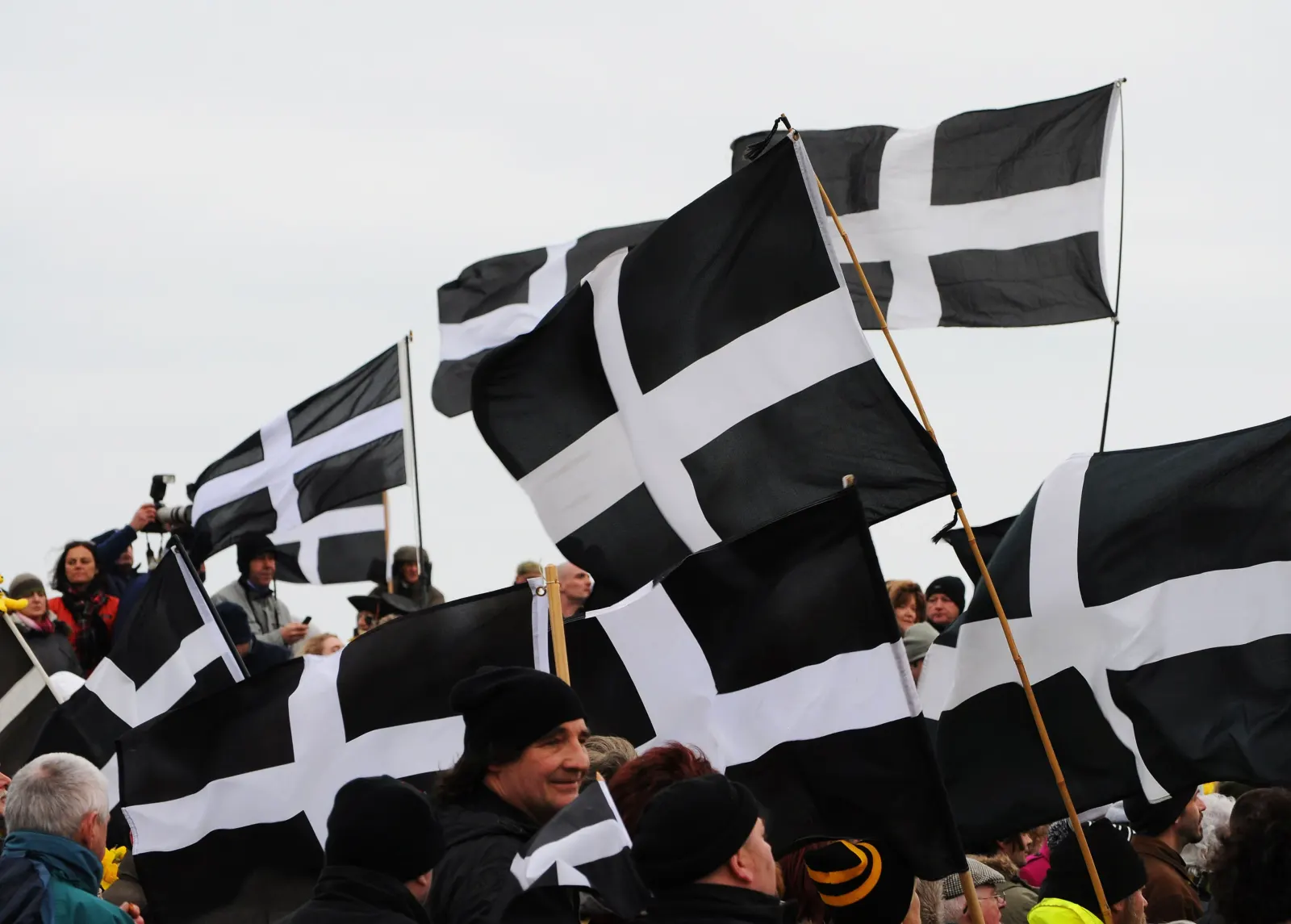
Comments
No comments yet — be the first to share your thoughts.
Leave a comment
Your email won’t be published. Comments are checked before they appear.