

9 articles
The Cornish flag, also known as Saint Piran’s Flag, is a white cross on a black background and is the traditional flag of Cornwall. It is one of the oldest regional flags in Britain and symbolises Cornwall’s tin-mining heritage and the patron saint – St Piran.
England has the cross of St George; Scotland has the St Andrew’s saltire. Here in Cornwall, we have Saint Piran’s Flag with its distinctive white cross on a black background (field). It is surely Britain’s most iconic regional flag and, in many ways, more Cornish than tin miners or a Cornish pasty. But what does it represent for the Cornish? And what were its origins?
In this article we explore:
- The history of the Cornish flag
- The meaning and symbolism of St Piran’s cross
- The legends surrounding its origins
- …and how it became a global symbol of Cornish identity.
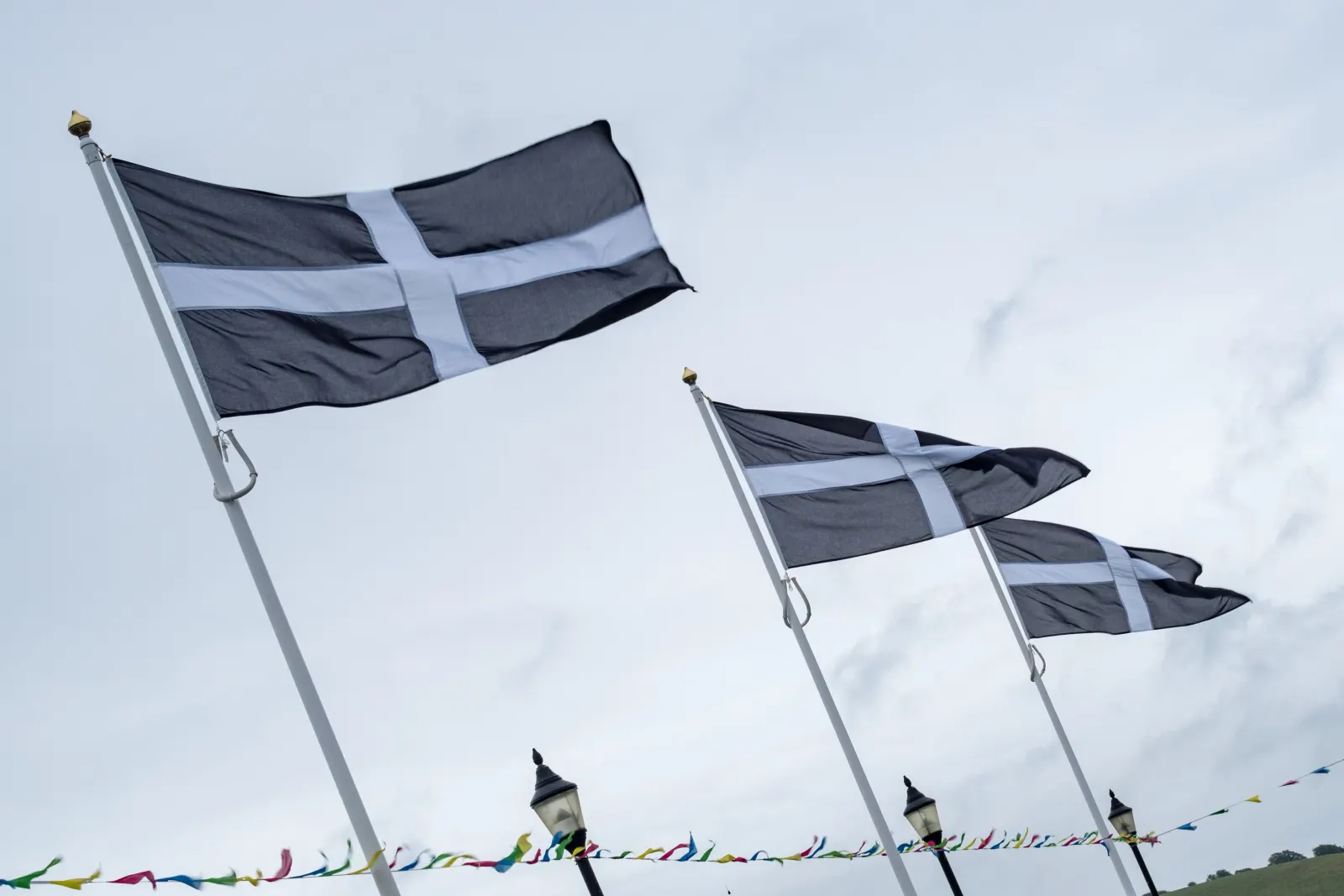
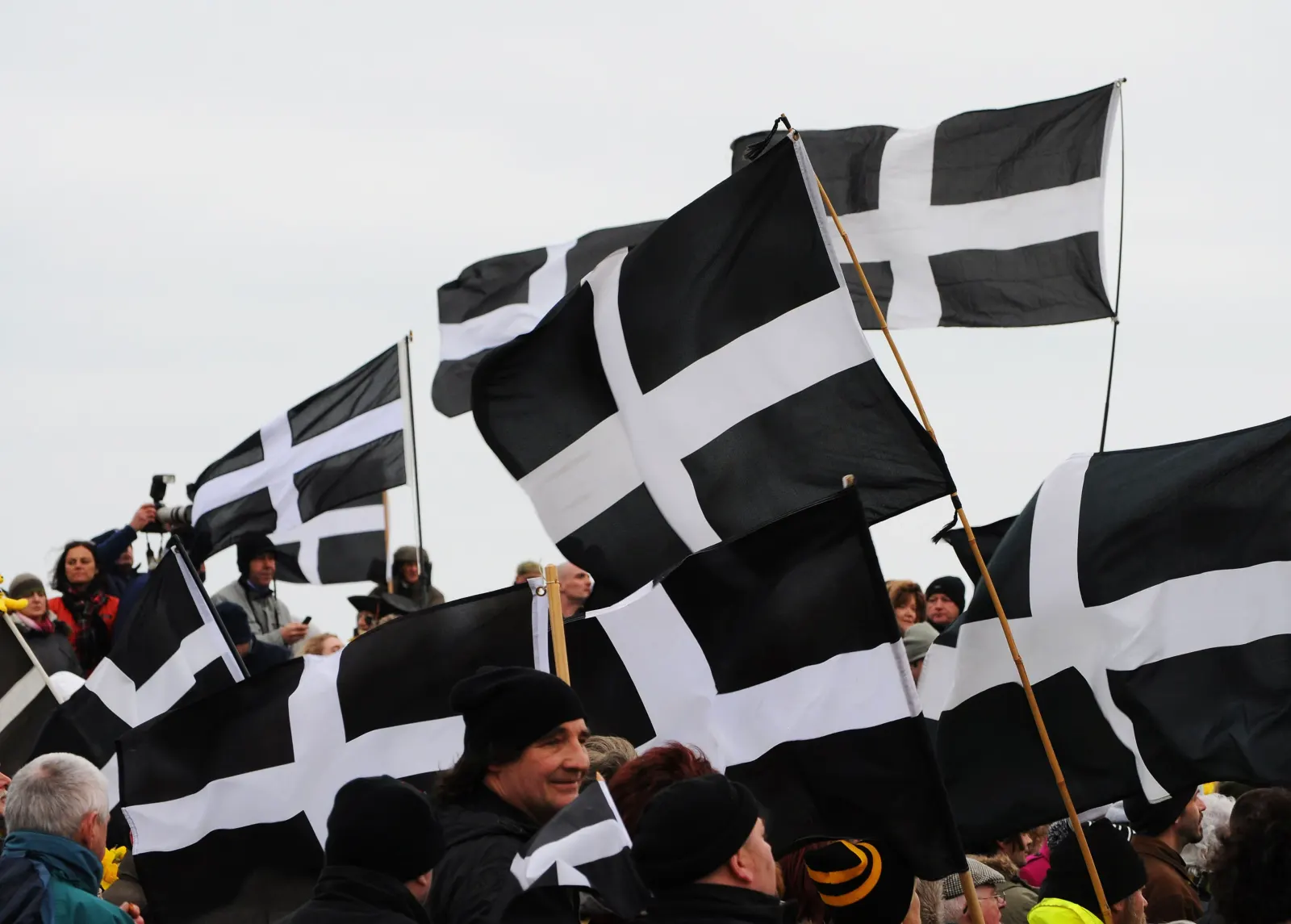
The Cornish Flag images
Cornish Flag Fast Facts
- Name: Cornish Flag / Saint Piran’s Flag
- Flag Design: White cross on a black background
- Associated Saint: Saint Piran
- First Recorded: 19th century
- Symbolism: White tin metal flowing from black ore
- Celebrated on: Saint Piran’s Day (5th March)
What Is the Cornish Flag?
What Does a Cornish Flag Look Like?
The Cornish flag (known as the Saint Piran’s flag) consists of a plain white cross on a black field. You’re sure to see it flying from a flagpole on public buildings across Cornwall. It is especially in evidence at Cornish cultural celebrations and sports events but, if you take the time to look, you’ll see it everywhere:
- on car bumper stickers,
- t-shirts,
- fridge magnets,
- pin badges,
- key rings,
- on every sort of knick-knack you might find in a Cornish gift shop,
- bunting at Cornish festivals,
- flying from a flagpole in a Cornish garden,
- even on naval ensigns.
Is the Cornish Flag a County Flag or a National Flag?
The Cornish flag occupies a unique position amongst British flags. As Cornwall’s flag it might be regarded as a county flag and, in that capacity, it is one of the older county flags. England has 39 officially recognised traditional county flags but of these only 11 (including the Cornish flag) pre-date the twentieth century.1
But Cornwall has a very distinct identity within the British Isles with its own unique culture and language. For much of its history, and by many people today, Cornwall is regarded as a nation in its own right. So, the Cornish flag is also a national flag, even though you won’t see it appearing on any union flags, unlike the flags of other nations in the United Kingdom.
No other regional flag in the UK enjoys this singular dual identity.
Cornish Flag Meaning and Symbolism
The Cornish flag is known as the St Piran’s flag (alternatively St Piran’s Cross). It is named after a 6th century Cornish saint, who is also the patron saint of tin mining. Tradition holds that the white cross on a black field represents silver tin flowing from black ore.2
5th March is traditionally celebrated as St Piran’s day and represents a time of year when the flag is especially prominent. In past times the celebration of St Piran’s day could be a boisterous affair, as evidenced by an old expression from the nineteenth century “drunk as a Perraner”.2
These days things are a little more restrained. You’ll find that many Cornish towns celebrate the occasion with parades and other festivities at around this time. This might include children’s parades, markets, literary events and other cultural celebrations.
On such occasions you’re likely to see its distinctive black and white colours out in force. Cornish streets are transformed with flag bunting, market stalls draped with table flags as throngs of people enthusiastically wave their hand flags. It is the time of year to celebrate the coming of spring and simply being Cornish.
Origins and Early History of the Cornish Flag
But what do we know about the origins of St Piran’s flag? When was it first used? And how did the Cornish come to adopt its design?
The earliest surviving historic reference to the flag dates to the first half of the nineteenth century.3 However, even then it was seen as a traditional flag with a well-established heritage.
Cornish tradition holds that its design dates back a lot further than this, all the way back to the time of Saint Piran, a 6th century Cornish saint and patron of tin mining.2
The Legend of the Saint Piran’s Flag
At this point, you might be wondering how a 6th century saint became associated with tin mining in the first place!
According to an old Cornish folktale, St Piran came to Cornwall from Ireland and established a small church on the north Cornwall coast near Perranzabuloe. In addition to ministering to the locals, the old saint was in the habit of collecting all manner of rocks, often selecting them for their distinctive or unusual colouration. One day, he used some of these rocks to build a fireplace. And, as it happened, some of these rocks contained tin. So, as the rocks grew hot with the fire, molten tin started flowing out of them. And thus, the saint discovered how to extract tin from the base ore!2
Armed with this fabulous discovery, St Piran quickly taught the locals what he’d learnt, thus founding Cornwall’s famous tin mining industry. Such wealth did it bring to Cornwall that the Cornish could not but help adopting Piran as their favourite saint. The flag therefore stands as a reminder not only of Saint Piran but also of Cornwall’s rich tin mining heritage.
Cornish Flag History
Does that sound like a tall tale? Perhaps. But if we set this old folk legend aside for now, what do we really know about the flag’s history?
The earliest surviving reference to the St Piran flag can be found in the writing of Davies Gilbert who, mentions it in his histories. In 1835 we are told that the flag was flying in the parish of Perranzabuloe. Davies describes it as follows:
“A white cross on a black ground was formerly the banner of St Perran and the Standard of Cornwall; probably with some allusion to the black ore and the white metal of tin.”3
He and other writers from the nineteenth century clearly assumed the flag had a long history prior to this time. But, alas, there are no earlier surviving references or images of the flag, and it is unclear where Gilbert got his information.
Where did the Cornish Flag come from?
Although we have a reference to the flag from 1835 there are many different theories as to its origins. Aside from the St Piran legend, these include:3
- It was largely a twentieth century invention.
- Davies Gilbert made it up.
- It began life as the medieval arms of the Earls of Cornwall.
- It was inspired by the cross of the same design used by the Knights Hospitaller.
- It was inspired by (and perhaps even originally was) a medieval Breton flag.
Was the Cornish Flag a twentieth century invention?
Some argued that it was primarily a twentieth century invention, promoted by various Cornish cultural advocates. Certainly, there is an argument to say that the flag was popularised during the twentieth century. However, there is no doubt that the flag pre-dates this time. Aside from Davies Gilbert’s account, images of the flag appear in nineteenth century stained-glass windows and, quite possibly, in an early black and white photograph from this period.3
Did Davies Gilbert Invent the Cornish Flag?
We have no record of the flag prior to Gilbert.3 So, it is theoretically possible that Gilbert did indeed make it up. However, this seems unlikely. His history was published in 1838. If he had completely fabricated the existence of such a flag, then surely his claims would have been robustly challenged by Cornish readers living at the time. But this did not happen.
Was the Cornish Flag a Standard of the Earls of Cornwall?
Although this is possible, it seems unlikely. As time went by the characteristic duchy flag of golden bezzants against a black field was increasingly adopted. This is clearly a very different flag.
In the case of some of the early earls we cannot be certain of all the devices/arms they may have used. So, it is possible that such a flag was used by one of the earlier Earls. Nevertheless, we have no firm evidence that a white cross on black field was ever used by a Cornish earl or duke.5
Did the Cornish Flag come from the Knights Hospitaller?
The Knights Hospitaller (also, Knights of St John) took possession of the estate of Trebeigh in Cornwall in 1314 and remained there until the dissolution in Tudor times.6
When fighting in the Holy Land, the Hospitaller’s surcoats featured a white cross on a black field. It was almost exactly the same design as the Cornish flag!
However, the Hospitallers dropped this old design, several decades before they took possession of Trebeigh, in favour of a white cross on a red field. So, the connection is not so strong as some have assumed.7
Did the Cornish Flag come from Brittany?
Cornwall has long had a close connection with Brittany. The Bretons are, after all, the closest Celtic cousins of the Cornish.
Brittany, as it happened, was a close ally of William of Normandy at the time of the Conquest. As much as one third of William’s army at the battle of Hastings consisted of Bretons. William duly rewarded several Breton knights with land and titles in Cornwall. This re-forged a close connection between Brittany and Cornwall that lasted throughout the Middle Ages.8
Breton medieval knights and nobles often used banners that featured crosses similar to the St Piran’s flag. For one thing the flag of Brittany (the Kroaz Du) featured a black cross on white background (the reverse image of the Cornish flag). However, a few Breton families are even known to have used standards almost identical to the St Piran’s flag.3
What are the True Origins of the Cornish Flag?
It seems most likely, therefore, that the flag of Cornwall had its origins in the Middle Ages and drew its inspiration from Breton designs with which Cornish people would have been familiar. As with all flags featuring crosses from this period, the symbolism was clearly Christian and (quite often) carried associations with saints. So, the association with St Piran probably evolved at a similar time. Although we lack any definitive proof, the Saint Piran flag mostly likely had its origins in the high medieval period of Cornish history.
Modern Revival and Popularisation of the Cornish Flag
In 1835, Davies Gilbert saw the St Piran’s Flag as ‘formerly’ the standard of Cornwall. At this time, then, it was perceived as perhaps something of an anachronism, a remnant of a bygone age. This being the case, how might we explain the huge popularity that the flag currently enjoys?
The explanation lies, in no small part, in the Cornish Revivalist movement of the 20th century.
Cornish Revivalism
By the early twentieth century Cornwall and Cornish identity was in crisis. The Cornish language had largely disappeared as a living language and traditional Cornish tin mining was in serious decline.4 However, as the twentieth century wore on a Cornish Revivalist movement sought to reverse the decline. The Revivalists strove to preserve traditional Cornish culture, reintroduce the Cornish language and foster a renewed sense of Cornish identity.
The Old Cornwall Movement
Part of this revival was the Old Cornwall movement, founded in 1920. By 1925 the movement encompassed a federation of branches across the county and dedicated itself to promoting Cornish language, poetry, folklore and culture. Part of this involved promoting St. Piran’s flag as a symbol of Cornish identity. In 1936, the movement wrote in its journal “If we took to this old cross-banner of Cornwall…we should probably have Cornwall more in evidence on occasions when the flags of all nations decorate the Cornish streets.”8
Since this time interest in and usage of the Cornish flag has continued to flourish. In this regard, it stands as a symbol of a renewed sense of pride in Cornish identity and a strengthened sense of regional culture.
What does the Cornish Flag mean?
The flag has acquired several different associations over the course of its history, including:
- Cornwall’s tin mining heritage: with the white cross symbolising tin and the black field representing the ore from which tin is extracted.
- Medieval Chivalry and the Crusades: standards using crosses have been in use since Christian Roman times. Throughout the Middle Ages they held strong associations with the defence of Christendom and, especially, the crusades. The medieval nobility adopted them as an emblem of divine favour and the chivalrous championing of righteous causes.
- Christian symbolism: These days, these standards have lost some of their medieval associations with chivalric culture. Nevertheless, the cross remains a potent symbol of Christian values more generally.
- Saint Piran: Medieval standards featuring crosses were often associated with specific saints (e.g. Saint George’s cross in England, Saint David’s cross in Wales and Saint Andrew’s saltire in Scotland). The Union Jack itself is a composite amalgam of saint’s crosses. In the case of the Cornish cross, the association is specifically with St Piran.
- Cornish identity: most obviously, the flag has become intrinsically linked with Cornish identity and culture. It is widely used in celebrations like St Piran’s day and often promoted by Cornish businesses and cultural organisations like Gorsedh Kernow (Cornish arts and literature). Whatever its historic significance, there can be no doubt that it is central to Cornish identity today.
The Cornish Flag and Cornish Identity Around the World
The Saint Piran’s flag not only holds significance for the people of Cornwall, but also for Cornish diaspora communities around the world.
In the late nineteenth and early twentieth century, as the traditional Cornish mining industry fell on hard times, many Cornish miners and their families migrated to seek work overseas in places like North America and Australia.
The Cornish in North America
Cornish miners came to North America to work in the mines, and you will often find Cornish diaspora communities in traditional mining areas there. There are as many as 2 million people of Cornish descent living in the USA today.10
Communities such as Grass Valley in California still celebrate St Piran’s Day today. The Saint Piran’s flag can be seen on prominent display on the day and plays a key role in reinforcing the city’s Cornish heritage.5
The Cornish in Australia
Many Cornish families emigrated to Australia, and the diaspora community is especially significant in South Australia (attracted, as the Cornish always were, by the mining industry).6
The Cornish Association of South Australia supports a thriving Cornish diaspora community and helps to organise cultural celebrations such as St Piran’s Day and a biennial Cornish cultural celebration – the Kernewek Lowender. And, of course, the Cornish flag features prominently in these events.7
Conclusion
The Saint Piran’s flag today is a key symbol of Cornish identity, both within Cornwall and around the world. It is undeniably a great source of cultural pride for the Cornish; you only need attend a Saint Piran’s Day celebration to see that.
Historically, it holds many deeply ingrained associations that strongly reflect how the Cornish see themselves. When Cornish people see the flag, they are immediately reminded of Saint Piran and Cornwall’s proud mining heritage.
Perhaps most importantly of all, the flag is a symbol of what it means to be Cornish. To be part of a region that has its own unique cultural heritage, language, folklore, and sense of nationhood. For some it represents Cornwall as a nation in its own right, albeit part of a United Kingdom. For everyone living or visiting Cornwall today it should serve as a reminder that Cornwall has a uniquely rich and distinct heritage for us to enjoy.
Article Sources
- Flag Institute (2026). Flag Institute: the Flag Experts. [online] The Flag Institute. Available at: https://www.flaginstitute.org/ [Accessed 6 Mar. 2026] Flag Institute[↩]
- Gutenberg.org. (2019). The Project Gutenberg eBook of Popular Romances of the West of England; or, The Drolls, Traditions, and Superstitions of Old Cornwall, by Robert Hunt. [online] Available at: https://www.gutenberg.org/files/59033/59033-h/59033-h.htm Gutenberg.org[↩]
- Rendle, P. (2021). Cornwall – The Mysteries of St Piran. Proceedings of the XIX International Congress of Vexillology, pp. 57-59[↩]
- British County Flags. (2013). Cornwall. [online] Available at: https://britishcountyflags.com/2013/04/07/cornwall-flag/ [Accessed 6 Mar. 2026]. British County Flags[↩]
- Wikipedia Contributors (2026). Earl of Cornwall. Wikipedia.[↩]
- Heritagegateway.org.uk. (2026). Heritage Gateway – Results. [online] Available at: https://www.heritagegateway.org.uk/Gateway/Results_Single.aspx?uid=436700&resourceID=19191 [Accessed 6 Mar. 2026]. Heritagegateway.org.uk[↩]
- Wikipedia. (2021). Knights Hospitaller. [online] Available at: https://en.wikipedia.org/wiki/Knights_Hospitaller Wikipedia[↩]
- Payton, P. (2017). Cornwall A History. Exeter: University of Exeter Press
- BBC.co.uk. (n.d.). BBC – Nation on Film – Tin Mining – The Rise and Fall of Cornish Tin Mining. [online] Available at: https://www.bbc.co.uk/nationonfilm/topics/tin-mining/background_decline.shtml BBC
- Wikipedia Contributors (2025). Cornish Americans. Wikipedia.
- Downtown Grass Valley. (2026). 2026 St. Pirans Day Celebration – Downtown Grass Valley. [online] Available at: https://downtowngrassvalley.com/gvda-events/2026-st-pirans-day-celebration/ [Accessed 6 Mar. 2026] Downtown Grass Valley
- Wikipedia Contributors (2026). Cornish Australians. Wikipedia.
- Cornish Association of South Australia Inc. (2022). HOME. [online] Available at: https://cornishsa.org.au/ [Accessed 6 Mar. 2026] Cornish Association of South Australia Inc
Frequently Asked Questions
St Piran’s Flag symbolises Cornwall’s tin-mining heritage and cultural identity. According to legend, Saint Piran discovered tin when white metal flowed from black rock during a fire. The white cross represents tin, while the black background represents the surrounding ore.
The Cornish flag is called St Piran’s Flag, named after Saint Piran, the patron saint of Cornwall and tin miners. It features a white cross on a black background and is widely recognised as the historic flag representing Cornish identity, heritage, and culture.
Yes. The Cornish flag is considered a Celtic flag because Cornwall is recognised as one of the six Celtic nations. These nations share cultural and linguistic heritage with regions such as Wales, Brittany, and Ireland.
The black and white colours are traditionally linked to Cornwall’s tin mining history. According to legend, white molten tin flowed from black ore when Saint Piran discovered tin. This symbolism explains the white cross on a black background.
The Cornish flag is not legally protected, meaning anyone can use or display it. However, it is officially registered as the historic county flag of Cornwall by the Flag Institute, which recognises traditional flags representing UK counties and regions.
The earliest reference to the flag is 1835, whereas the earliest reference to St Piran’s Day celebrations is eighteenth century. Both are likely older. However, the modern observance of St Piran’s day as a celebration of Cornish national identity, did not begin until the late 19th/early 20th century.
The Cornish flag is used to represent Cornwall’s identity, culture, and heritage. It is flown on public buildings, homes, and businesses across Cornwall, and is commonly displayed during festivals, sporting events, and cultural celebrations.
Yes. The Cornish flag is visually similar to Saint David’s Flag, which features a yellow cross on a black background. Both designs use a bold cross motif and reflect historic Christian symbolism associated with Celtic saints.
The exact designer of the Cornish flag is unknown. The earliest known reference appeared in 1838 by Davies Gilbert, who described it as the traditional banner of Cornwall, suggesting the design was already in use before that time.
Many Cornish people regard St Piran’s Flag as Cornwall’s national flag. While Cornwall is part of the United Kingdom, the flag is widely used to represent the distinct cultural identity, history, and traditions of the Cornish people.
Cornwall is officially a ceremonial county of England, but it is also recognised as one of the historic Celtic nations. In 2014, the UK government recognised the Cornish people as a national minority under the Council of Europe Framework Convention.
The cross design is associated with Saint Piran and early Christian symbolism. The white cross represents Christianity, while the black background is often linked to Cornwall’s mining heritage and the dark rock from which tin was historically extracted.
Written by
Paul Watts is a local writer based in Launceston with a keen interest in history and folklore, having studied A History of Folklore at Oxford University. He is the author of Myths and Legends of the Medieval World (Pen & Sword Books) as well as a leading medieval history blog (named a ‘Top blog’ by Feedspot in 2025)
9 articles published on Cornwall.co.uk
Read more from Paul Watts →



Comments
No comments yet — be the first to share your thoughts.
Leave a comment
Your email won’t be published. Comments are checked before they appear.