

13 articles
When you think of Cornwall, it’s hard not to salivate at the conjuring up of images of Cornish pasties. But aside from its delicious flavour, what makes this Cornish food so special? From its fascinating origins and importance in the Cornish tin mines, to inspiring dishes around the globe and its recent designation as a protected food, there is far more to this humble hand pie than many would assume. In this blog, we explore the pasty’s origins, how they tie in with Cornish history and culture and how you can make your own at home. Plus, we uncover the Cornish pasty controversy and where you can find the best traditional pasties in Cornwall.
What is a Cornish Pasty?
Alongside scones with jam and cream, pasties are Cornwall’s most famous food. But what exactly is a Cornish pasty?
Origins
The first known reference of a Cornish pasty is in Chetrien de Troyes Arthurian Romances written in the latter half of the 12th century.1 This means they have been consumed by the people of Cornwall for at least 900 years. Once a food for the rich upper class and royalty in the 13th century, by the 18th and 19th centuries pasties evolved to meet the needs of Cornish miners.2 At this time, thousands of men worked in the Cornish tin and copper mines and pasties were a staple part of their diet.3
Cornish Pasty Ingredients
When consumed by the nobility, pasties had rich fillings including venison, eels, beef and lamb, flavoured by rich gravies and fruits.4 However, what we consider a traditional Cornish pasty is the version popularised by miners’ wives. The ingredients are beef, pastry, onion, potato and swede, plus seasoning.5
Shape
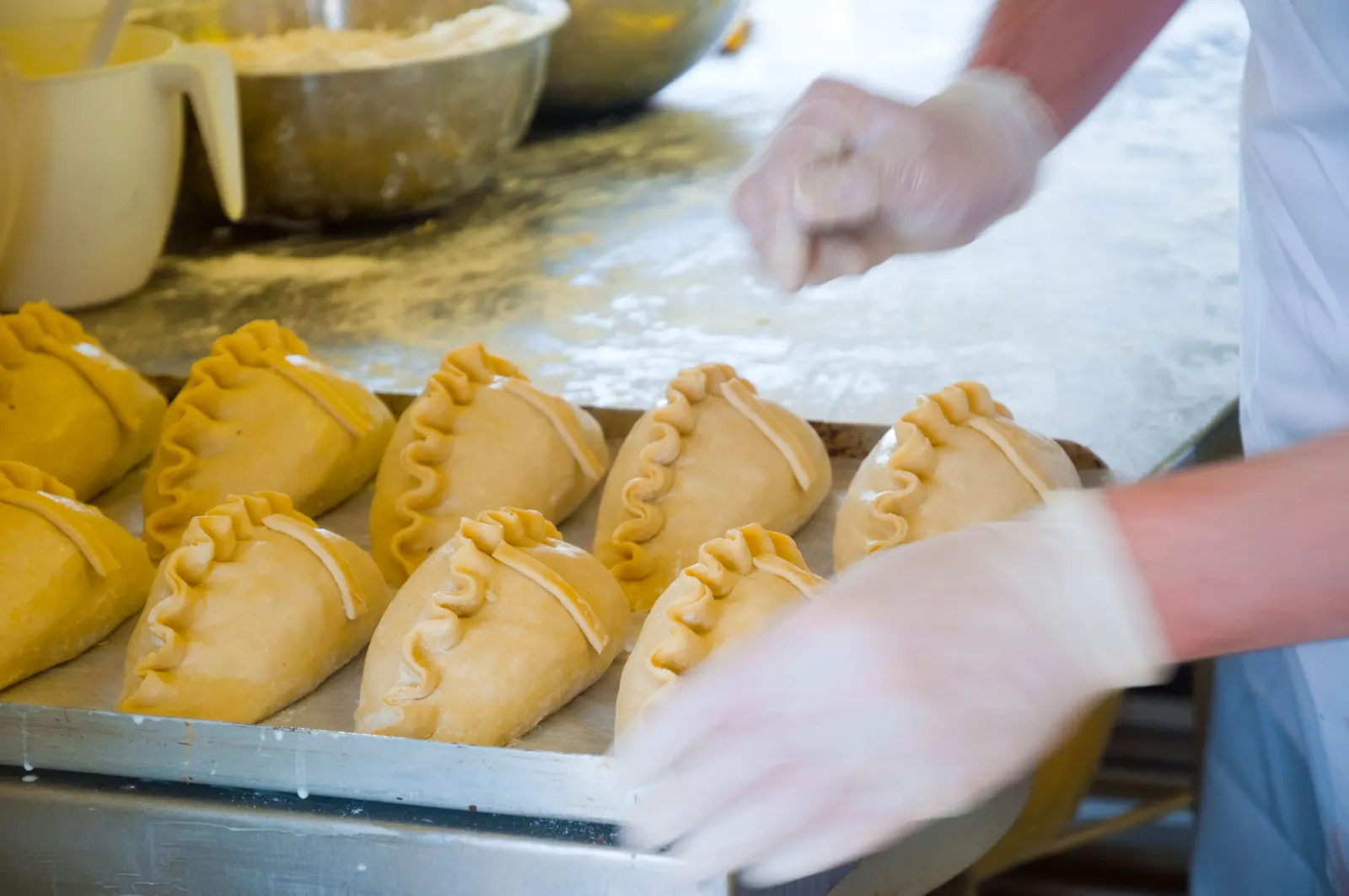
Pasties are the perfect example of a functional food, designed to provide a nutritious and substantial meal whilst withstanding the rigours of working in the mines. Their distinct D-shape and thick crust are an intentional part of their development. The pasty’s thick crust protected miners from the dust, dirt and arsenic they had on their hands from working in the pit and were traditionally baked hard to be stored in the pocket.3 The shape of the pasty also made it easy to carry and for miners to store them against their bodies for heat whilst working.6
The History of the Cornish Pasty
Spanning for almost a thousand years, the history of the Cornish pasty is tied to Cornish identity, culture and the Cornish diaspora. They are also part of Cornish food heritage.
Early Origins
During the reign of King Henry III in the 13th century, pasties were considered a luxury food. However they grew in popularity during the following centuries, eventually becoming a firmly established part of the working class diet. Originally containing readily available and affordable ingredients including vegetables, potatoes, swede and onion, small quantities of beef were later added. They were also a convenient and durable food to eat at work or on the go by miners and agricultural workers.6
Pasties and Mining
You may already know about pasties being part of the history of Cornish mining food. During the mining boom of the 17th and 18th centuries, pasties became more popular than ever and formed an essential part of the daily diet. Miners would work long days in total darkness deep in the pits and at lunchtime pasties made by their wives would be dropped down the mineshaft. Once unwrapped, workers would use the crust as a handle and consume the rest of the pastry and filling. The crust was then discarded to avoid poisoning from the dirt and arsenic on the miners’ hands.7 Therefore, pasties are deeply entwined with Cornwall’s mining heritage.
Pasties and Emigration
The Cornish mining industry collapsed in the latter part of the 19th century, as new deposits of copper and other metals and minerals were found around the globe. As a result, Cornish miners, considered the most skilled in the world, emigrated in increasing numbers to other continents. Around a third of the Cornish population left in search of better prospects.8 They took the pasty with them to Mexico, South America, North America, Africa, Australia and New Zealand – thus this humble food became part of an international diet spread by the Cornish diaspora.10
A Cornish Export
Today, over 120 million Cornish pasties are made each year and their ingredients contribute more than £15 million to growers and farmers in Cornwall.9 Whilst many of these pasties are consumed in county, both by locals and visiting tourists, they are also one of Cornwall’s most successful food exports.10 Cornish pasties can be found in bakeries around the UK but are also shipped internationally to countries as far as Japan, Australia and the USA.10 The sale of pasties contributes more than £300 million in trade to the Cornish economy.11
Pasties: Protected Status
In 2011, the Cornish pasty was granted Protected Geographical Indication – or PGI status by the EU, confirming its significance as an important part of Cornish heritage.3 This means that Cornish pasties can only be produced in the Cornish region.14 In 2024, the Cornish pasty also gained PGI status in Japan as part of a post-Brexit trade deal.12
PGI Cornish pasty explained: Protected Geographical Indication or PGI status means that only pasties made in Cornwall using an authentic Cornish pasty recipe including pastry, potato, steak, onion and swede can be legally sold as Cornish pasties.
How to Make a Traditional Cornish Pasty
Try out this traditional Cornish pasty recipe to make 4 large pasties to be enjoyed at home. Each pasty is about 1,200 kcal.13 Rest assured, this is an authentic Cornish recipe.17
Ingredients
Our recipe includes instruction on how to make a shortcrust pastry and the filling for a perfect pasty, but for an easier option shop bought shortcrust pastry also works well.
Ingredients for the Pastry
- 125g chilled butter
- 125g chilled lard
- 500g strong bread flour
- 1tsp salt
- 175ml cold water
- 1 beaten egg to glaze
Ingredients for the Filling
- 350g beef skirt or chuck steak, diced
- 1 large onion, finely chopped
- 2 medium potatoes, peeled and diced
- 175g swede (rutabaga), peeled and diced
- Black pepper to season
Method
- Add the strong bread flour to a large mixing bowl. Gently rub the lard and butter into the flour along with a pinch of salt. The texture should be similar to breadcrumbs.
- Add cold water to the flour mixture and knead into a strong dough.
- Cover the dough with clingfilm and chill in the fridge for at least 2 hours.
- Roll out the pastry and cut out four circles approximately 20 cm in diameter. Use a side plate as a guide.
- Layer the uncooked vegetables and meat equally between the four pastry circles, along with a pinch of salt and pepper. Leave a little space around the edges for crimping.
- Fold the pastry over to create a semi-circle and brush beaten egg around the edge. Press the edges together to create an initial seal. Then, crimp by using your thumb and forefinger to create folds in the edge of the pastry.
- Place onto a non-stick baking tray and glaze the outside of the pasty using the rest of the beaten egg.
- Bake at 180C/ 165C (fan) for 50 minutes or until the pastry is a golden colour.
Breakout Panel: How to Crimp a Pasty
Every authentic Cornish recipe for pasties includes crimping the edge to seal the contents in the pastry. Here is our guidance on exactly how to crimp a pasty using the traditional Cornish crimping technique: Fold the pastry in half to create a D-shape with an inch around the edge of the filling and gently seal. Starting at one edge, pinch the dough between your thumb and index finger, then place your other thumb on the dough. Fold the pastry up and over your thumb, and seal it again at the edge of the filling. Then move your thumb along and continue the process, to create a rope-like edging.
Cornish Pasty Flavours
Though there is only one genuine Cornish pasty flavour, today you will discover a huge selection of pasty filling ingredients. These are the most popular according to a survey of 100 pasty shops in Cornwall.14
- Traditional Cornish pasty – The authentic Cornish pasty recipe, which includes pastry filled with beef, potato, swede, onion, salt and pepper.
- Steak and stilton – An indulgent take on the traditional Cornish pasty, these include steak, swede, potato and onion along with creamy stilton cheese.
- Chicken – Creamy and full of flavour with ingredients which include chicken breast, potatoes, swede and onion in a creamy, peppery sauce.
- Cheese and onion – The most popular vegetarian option, including cheddar, potatoes, mustard and onion.
- Vegetable pasty – The original recipe, minus the beef, which is how working class people in Cornwall centuries ago would have often eaten their Cornish pasties.
- Lamb and mint – Swap beef for minced lamb alongside the usual swede, potato and onion, plus a dash of mint sauce for extra flavouring.
- Pork and apple – Combines sweet and savoury flavours including pork, potato, apples, onion and herbs.
- Spicy pasties – A whole host of spicy pasties are available including curry flavourings in both meat and meat-free varieties.
There are a huge number of pasty fillings beyond this, including a growing number of gluten free and vegan pasty options.
Regional Variations in the UK and Around the World
As a result of Cornish migration, regional variations of the Cornish pasty have sprung up around the globe. From the 17th century onwards, increasing numbers of Cornish folk moved to different parts of the world to work in mines, taking their skills, culture and cuisine with them. However, the pasties we find around the world are different – in some cases extremely different – to the pasties eaten in Cornwall.
Pasty Variations in the UK
Cornish miners began migrating to other parts of the UK from the early 1700s, including Wales, northern England and northern Ireland.15 Regional variations of the pasty therefore appear across the UK including regions near and far from Cornwall.
Devon – Geographically the closest region in England to Cornwall, Devon has its own version of the pasty. The main difference is that a Devonshire pasty is crimped on top to create more of an oval shape than the traditionally side-crimped and D-shaped Cornish pasty.16
Wales – The Welsh ‘Oggie’ is similar to a Cornish pasty in shape, but is traditionally filled with lamb, potato and leek.17 Whilst Cornish miners did move to work in Welsh mines during 1700s, some claim that Wales had already created the Oggie, before the Cornish arrived there.
Rest of the UK – Other variations of pasties exist across the UK, but are not as well established as in Cornwall, Devon and Wales. For example, in Ireland roasted meet tends to be used and in Cumbria pasties are sometimes sold with half sweet, half savoury fillings.
Pasties from Around the Globe
By the 18th century, Cornish workers were moving to mines all over the globe, because they were considered the best miners in the world. Discover theses global pasty variations and what makes them different to pasties in Cornwall:
- South Australia – The south Australian pasty comes as the result of 16,000 Cornish people emigrating there in the 19th century18– particularly in the area just outside of Adelaide and what is known as the Copper Triangle.19 Pasty bakeries are common in this region, however the south Australian pasty favours minced beef and often includes vegetables like peas and carrots.20
- North America – In the 1840s the ‘Copper Rush’ in Upper Michigan drew Cornish miners to the Keweenaw district also known as Copper Country.21 By the mid 20th century the pasty became a hallmark of Copper country cuisine.22 Michigan pasty ingredients tend to follow those of the traditional Cornish pasty, though sometimes include pork as well as beef.
- Mexico – In 1825, Cornish miners arrived in Real del Monte, Mexico to help solve the issue of flooding in the silver mines there.23 Since then, the pasty – or paste – has become Real del Monte’s regional food. However, Mexican pasties contain beans with chilli peppers (mole sauce) chicken, potatoes and pineapple.24 The city is also home to the world’s first pasty museum.25
- South America – Cornish miners worked in Latin America as early as the 1760s, starting with the silver mines of Peru.26 They later emigrated to Argentina and many other countries in Latin America.27 Empanadas are the South American version of the Cornish pasty and include ingredients like meat, chicken, cheese and vegetables. However, some claim empanadas had already been brought to the region by the Spanish during their colonial rule.
What Makes a Genuine Cornish pasty?
According to the Cornish Pasty Association, a genuine Cornish pasty must include a minimum of 12.5% beef (no other meat) and 25% vegetables. All of the ingredients must be uncooked when the pasty is put together and slowly baked until golden and succulent.
The ingredients are limited to: diced or minced beef, diced potato, swede, onion, salt and pepper. However, there are less rules around the type of pastry that is used. Shortcrust pastry, puff pastry and flaky pastry are all accepted as long as it is savoury and doesn’t fall apart whilst being eaten. The pastry can also be glazed according to personal preference.
To make a pasty truly Cornish is has to be crimped to create the iconic D-shape – and of course, anything made east of the Tamar bridge which divides Cornwall from the rest of the country is immediately disqualified.29
When a Cornish Pasty Isn’t ‘Proper’
Despite the clear guidance on what makes a genuine Cornish pasty, there are still many pasties which are made which aren’t ‘proper’ pasties. Here’s what to look out for:
- Made in Devon – Devon has long tried to claim the pasty and even exports pasties of their own. However, a Cornish pasty is only Cornish if it was made in the county. Check its origin before you head to the checkout.30
- Inferior ingredients – Use of inferior ingredients or using different vegetables are also a common sign of a non-genuine pasty. One of the most common mistakes is using carrots instead of Swede.4
- Crimped on the top – You’ll see some recipes crimping their pasties on the top – that’s the Devonshire way. But for a pasty to be ‘proper’ it must be crimped on the side to create the iconic D-shape.16
- Doesn’t form a complete meal – A pasty is designed to be a filling and complete meal. If it’s just a snack or you’re hungry afterwards it’s not a proper Cornish pasty.
The Best Cornish Pasties
If you’re wondering where to eat Cornish pasties in Cornwall, these bakeries have been voted the best across a number of competitions including the World Pasty Championships.
- Proper Cornish – Located near Bodmin, Proper Cornish’s traditional steak pasty won the Taste of the West awards in 2025 with their popular family recipe.31
- Cornish Premier Pasties – Gold Award winners at the last Pasty World Championships in 2022, and receiving awards in every year of the championships since 2016, Cornish Premier Pasties in Bude are known for their traditional methods and top-quality steak from their on site butchery.32
- St Agnes Bakery – One of Cornwall’s oldest bakeries, opened in 1905, St Agnes Bakery is known for its use of high-quality Cornish ingredients and fantastic pastry and has won both regional and international awards.33
- Ann’s Pasties – Based in Helston, but loved across the county for their flaky pastry and generous fillings, Ann’s pasties have won a number of awards at Cornish foodie events.34
- Gear Farm – Reputed for their exceptional organic ingredients grown and reared on their farm on the Helford, Gear farm are also praised for the generous size of their delicious pasties.39
- Proper Pasty Company – Another World Pasty Championships winner, Proper Pasty Company bake their Cornish pasties in St Columb but also sell them by post, meaning you can taste an authentic Cornish recipe wherever you are.40
- Chough Bakery – Named after the Cornish national bird, Chough Bakery is a family-run bakery in Padstow, known for their delicious Saffron Cake as well as their Cornish pasties.35
Conclusion
All in all, the Cornish pasty plays an important role in Cornish history, culture and heritage. Throughout the centuries it has evolved from a luxury food item reserved for the nobility, to a staple of a working class diets particularly for miners and those working in agriculture. Today, pasty shops and bakeries continue to thrive not only in Cornwall, but also overseas, after the food was spread around the globe by Cornish miners who went to work in other countries.
The importance of pasties as a part of Cornish heritage was recognised by the EU in 2011 when they granted the Cornish pasty Protected Geographical Indication – which means genuine Cornish pasties only include those which are baked in the Cornish region. To taste one for yourself, you can visit one of Cornwall’s award winning bakeries or try out our authentic Cornish recipe.
Article Sources
- Chrétien de Troyes (2000). Erec and Enide. Translated by Ruth Harwood Cline. Athens, GA: University of Georgia Press[↩]
- Historic UK (no date). The Cornish Pasty [online]. Available at: https://www.historic-uk.com/CultureUK/The-Cornish-Pasty/ Historic UK[↩]
- Norway, A. H. (2023). A History of Sport in Europe in 100 Objects. Arete Verlag[↩]
- Historic UK (no date). The Cornish Pasty [online]. Available at: https://www.historic-uk.com/CultureUK/The-Cornish-Pasty Historic UK[↩]
- Rick Stein (no date). Rick Stein’s Cornwall: Cornish Pasty Recipe [online]. Available at: https://rickstein.com/blog/rick-stein-cornwall-cornish-steak-pasty-recipe Rick Stein[↩]
- Harris, A. P. (1988). Fare of the country; in Cornwall, a meal in a crust. New York Times[↩]
- Great British Chef (2015). Cornish pride: a history of the pasty [online]. Available at: https://www.greatbritishchefs.com/features/cornish-pasty-history Great British Chef[↩]
- Walker, H. (ed.) (2001). Food and the Memory: Proceedings of the Oxford Symposium on Food & Cookery, 2000. Totnes: Prospect Books[↩]
- Zwegers, B., 2018. Goldmine or bottomless pitt? Exploiting Cornwall’s mining heritage. Journal of Tourism, Heritage & Services Marketing, 4(1), pp.15-22[↩]
- The Guardian (2011). A short history of Cornish pasties [online]. Available at: https://www.theguardian.com/lifeandstyle/2001/apr/21/foodanddrink.features31 The Guardian[↩]
- Great Cornish Food (no date). Evolving the classics [online]. Available at: https://greatcornishfood.co.uk/about-cornish-food/evolving-tradition Great Cornish Food [↩]
- GOV.UK (2024). UK businesses welcome protection for iconic British food and drink in Japan [online]. Available at: https://www.gov.uk/government/news/uk-businesses-welcome-protection-for-iconic-british-food-and-drink-in-japan#:~:text=Trade%20Policy%20Minister%20Greg%20Hands,businesses%20grow%20and%20export%20more GOV.UK[↩]
- Cornish Pasty Association (no date). Did you know? [online]. Available at: https://cornishpastyassociation.co.uk/about-the-pasty/facts-and-figures Cornish Pasty Association [↩]
- Alcock, J.P., 2010. Food and Language: What’s In a Name?. In Food and Language: Proceedings of the Oxford Symposium on Food and Cooking 2009 (Vol. 28). Oxford Symposium[↩]
- Chartered Institute of Export and International Trade (2024). Cornish pasties, Cumberland sausages and Welsh Caerphilly among UK goods gaining geographical protection in Japan [online]. Available at: https://www.export.org.uk/insights/trade-news/cornish-pasties-cumberland-sausages-and-welsh-caerphilly-among-uk-goods-gaining-geographical-protection-in-japan/#:~:text=Search…-,Cornish%20pasties%2C%20Cumberland%20sausages%20and%20Welsh%20Caerphilly%20among%20UK%20goods,Welsh%20Lamb%20in%20the%20UK Chartered Institute of Export and International Trade[↩]
- BBC Good Food (no date). Cornish pasty [online]. Available at: https://www.bbcgoodfood.com/recipes/perfect-pasties BBC Good Food[↩]
- Cornish Pasty Association (no date). Genuine Cornish pasty [online]. Available at: https://cornishpastyassociation.co.uk/about-the-pasty/make-your-own-genuine-cornish-pasty/ Cornish Pasty Association[↩]
- The Valley (2022). The Pasty Guide: What to Look For in a Pasty When Visiting Cornwall [online]. Available at: https://www.thevalleywww.cornwall.co.uk/news/pasties-to-try-in-cornwall/ The Valley[↩]
- Cornish Mining World Heritage (no date). The spread to other world regions [online]. Available at: https://www.cornishmining.org.uk/about/mining-in-cornwall-and-west-devon/mining-around-the-globe/the-spread-to-other-world-regions Cornish Mining World Heritage[↩]
- Harris, A.P., 1988. FARE OF THE COUNTRY; In Cornwall, a Meal in a Crust. The New York Times[↩]
- Webb, A., 2011. Food Britannia. Random House[↩]
- Payton, P., 2015. Place, Community and Identity: South Australia’s Cornish Mining Landscapes. ICOMOS: Fabric-The threads of Conservation[↩]
- Neale, E.K.R., 2018. Cornish Carols: Heritage in California and South Australia (Doctoral dissertation, Cardiff University and University of Exeter[↩]
- Skinnymixers (no date). Cornish Style Pasties – homemade pasty recipe [online]. Available at: https://skinnymixers.com.au/skinnymixers-cornish-style-pasties Skinnymixers[↩]
- Schwartz, S.P., 2017. Bridging “the great divide”: the evolution and impact of Cornish translocalism in Britain and the USA. In Immigration, Incorporation and Transnationalism (pp. 155-174). Routledge[↩]
- Stano, S., 2017. Eating Diversity, Creating Identity: Translations of the Culinary Code Between Creativity and Misunderstandings. In Readings in Numanities (pp. 85-92). Cham: Springer International Publishing[↩]
- Lozada Amador, E. and Lagarda García, F.O., 2021. Recognition and Reuse of Industrial Heritage for its Conservation. Cornish Machine Houses in Pachuca and Real del Monte, Hidalgo, Mexico. Intervención (México DF), 12(24), pp.176-221[↩]
- Montiel, E., 2018. The traditional flavors of Hidalgo. Voices of Mexico[↩]
- Culture Trip (2017). Mexico’s Cornish Connection: The Central Mexican Town Known for the Iconic British Pasty [online]. Available at: https://theculturetrip.com/north-america/mexico/articles/mexicos-cornish-connection-the-central-mexican-town-known-for-the-iconic-british-pasty Culture Trip[↩]
- Rowe, J., 1959. Cornish Emigrants and America. Bulletin of the British Association for American Studies, 8, pp.4-11[↩]
- Payton, P., 2005. The Cornish Overseas: a history of Cornwall’s’ great emigration’. Dundurn[↩]
- Kernewek Lowender (no date). About [online]. Available at: https://www.kernewek.org/about Kernewek Lowender[↩]
- Cornish Pasty Association (no date). About the pasty [online]. Available at: https://cornishpastyassociation.co.uk/about-the-pasty Cornish Pasty Association[↩]
- GOV.UK (2021). Cornish Pasty [online]. Available at: https://www.gov.uk/protected-food-drink-names/cornish-pasty GOV.UK[↩]
- Proper Cornish (no date). Awards [online]. Available at: https://www.propercornish.co.uk/awards/ Proper Cornish[↩]
- Cornish Premier Pasties (no date). Home [online]. Available at: https://www.cornishpremierpasties.co.uk Cornish Premier Pasties
- St Agnes Bakery (no date). Home [online]. Available at: https://stagnesbakery.co.uk St Agnes Bakery
- Ann’s Pasties (no date). Home [online]. Available at: https://www.annspasties.co.uk Ann’s Pasties
- Facebook.com (no date). Gear Farm Pasty Co [online]. Available at: https://www.facebook.com/GearFarmPastyco/ Facebook.com
- Proper Pasty Company (no date). Home page [online]. Available at: https://www.properpasty.co.uk Proper Pasty Company
- Chough Bakery (no date). Home page [online]. Available at: https://www.cornishpasty.com/our-padstow-shop/#:~:text=You’ll%20find%20breakfast%20baps,Cornish%20food%20and%20drink%20products Chough Bakery
Frequently Asked Questions
Cornish pasty controversy was known as “Pastygate” – a UK political scandal where the Conservative government proposed a 20% VAT on hot foods like pasties. Following public and media backlash—especially from Cornwall—Chancellor George Osborne reversed the decision, and the tax was dropped
The best meat for traditional Cornish pasties is beef skirt, chuck steak, or occasionally minced beef. Though modern versions may use chicken or lamb, beef remains the classic and most authentic filling.
A Cornish pasty is a traditional pastry from Cornwall with a specific filling of beef, potato, swede, and onion, crimped on the side and protected by Protected Geographical Indication (PGI) status, meaning only pasties made in Cornwall can be called “Cornish.” A normal pasty can have any filling and shape and doesn’t need to follow these traditional rules.
Pasties come in a whole range of fillings, with popular flavours including steak pasties, cheese and onion pasties, chicken pasties and vegetable pasties. However, for it to be a Cornish pasty it must stick to a traditional recipe containing only beef, swede, onion, potato, salt and pepper.
Cornish pasties can be part of a balanced diet but are relatively high in calories, fat, and carbohydrates due to the pastry and meat filling. Choosing smaller portions, lean meat, or vegetable fillings makes them a healthier option while still enjoying this traditional Cornish food.
The secret of the Cornish pasty is to stick to a strict recipe, which contains nothing more than pastry, beef, potato, swede, onion, salt and pepper. The ingredients must be sealed into the pastry when they are uncooked and crimped along their side to make a distinctive D-shape.
The best Cornish pasties are found in Cornwall, where everyone has a favourite family recipe or bakery. Notably, Cornish Premier Pasties have won awards at the World Pasty Championships every year since 2016.
To make a Cornish pasty from scratch, you must first make your own pastry by combining strong bread flour, lard, butter and salt. Once you’ve rolled out the pastry you fill it with beef skirt, swede, potato and onion before crimping into a D-shape and placing in the oven.
Yes — many bakeries in Cornwall offer vegetarian Cornish pasties, often filled with cheese, potato, and vegetables, while keeping the traditional hand‑crimped pastry style.
Yes, Cornish pasties freeze well, either raw or baked. To enjoy, reheat in the oven for the best flavor and texture.
To eat a Cornish pasty, hold it by the crimped edge, which was traditionally not eaten by miners. Bite into the soft pastry and savoury filling for a classic Cornish food experience.
The Cornish pasty wasn’t invented by one person. It developed in Cornwall in the 18th century, created by local communities as a portable meal for tin miners, using beef, potato, swede and onion sealed in pastry.
Written by
Lydia Paleschi is a Falmouth local and freelance writer whose family have been based in Cornwall for many generations. However, it wasn’t until she spent several years living in Cardiff and London that Lydia realised that living next to the ocean is where she belongs. After moving back to Falmouth and launching her freelance career in order to make the most of a Cornish lifestyle determined by weather and tides, Lydia now spends most of her free time wild swimming and sailing in Cornish waters. And despite being lucky to travel far and wide – sailing as far away as Central America – it is the Cornish coastline that Lydia finds provides the greatest nourishment to her soul. More recently, Lydia has been exploring Cornwall in her van, which has only made her fall in love with her home county more. Lydia’s book A Guide to Wild Swimming in Cornwall aims to help others share in her love of the Cornish coastline and the wellbeing benefits that can be enjoyed by spending time there.
13 articles published on Cornwall.co.uk
Read more from Lydia Paleschi →





Comments
No comments yet — be the first to share your thoughts.
Leave a comment
Your email won’t be published. Comments are checked before they appear.